Salt Lake City // We’re Just Bones and Teeth
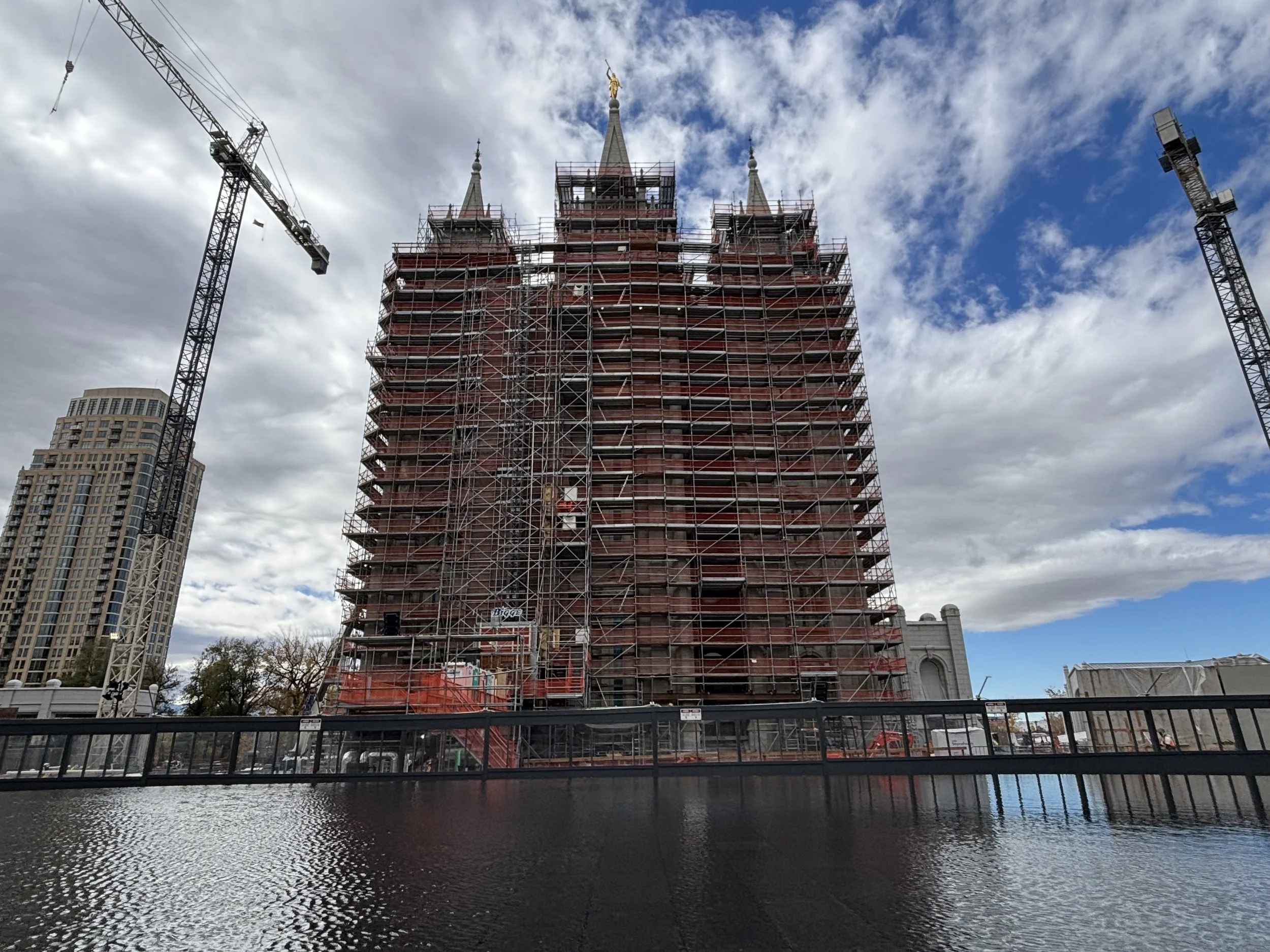
The Salt Lake Temple © John Bills
Full disclosure: I was hoping that this would blossom into 1,500 words that make sense of the Mormon story, an article that perfectly captures the vital sense of hope and trepidation that filled the groups as they moved west in search of home. I hoped that, somehow, through a mixture of historical retellings and recapping my own experiences in Salt Lake City, I could leave the reader with a sense of clarity about one of the largest of all modern religious movements. There would be some Joseph Smith, some Brigham Young, a little bit of storytelling, and we’d reach a fine conclusion, bridging the divide between education and engagement through my usual clumsy attempts at Dyer-meets-Calvino sculpting. We won’t be doing that today, because that is impossible.
And if you’ll forgive the tangent, finding a book in Utah Book & Magazine was every bit as impossible. Casey had recommended the place, albeit in an incredulous manner that suggested it was less a book shop and more an experience. That was my assumption, and my assumption was correct. It took a while to find it, roadside construction doing a solid job of obscuring the entrance, but I eventually found it. I figured I’d go in, take a look around (it’s Limp Bizkit, fuckin’ up your town), clock a copy of Invisible Cities, and continue my aimless wandering around downtown Salt Lake City, but that figurin’ was soon out the window.
It wasn’t the most inviting of places. A hand-scrawled sign on the door implored visitors to close it behind them, and the raggedness of the writing suggested a lot of caring but not much care. I inherently agreed with the sign and toyed with the idea of a “born in a barn” joke in the heart of the Latter-day Saints' homeland, but ultimately thought better of it. By that, I mean I couldn’t think of a joke in the time it took me to enter the shop and carefully close the door behind me. Besides, there was a dude slumped on a chair to the immediate left of the entrance, two cans of beer balanced perilously on a pile of books next to him, and he may or may not have been asleep. Sometimes, you just don’t know. I said hello to the woman behind the counter, and she sort of grunted in my vague direction. I’m reticent to judge, but it looked unlikely that there would be a copy of Invisible Cities in there.
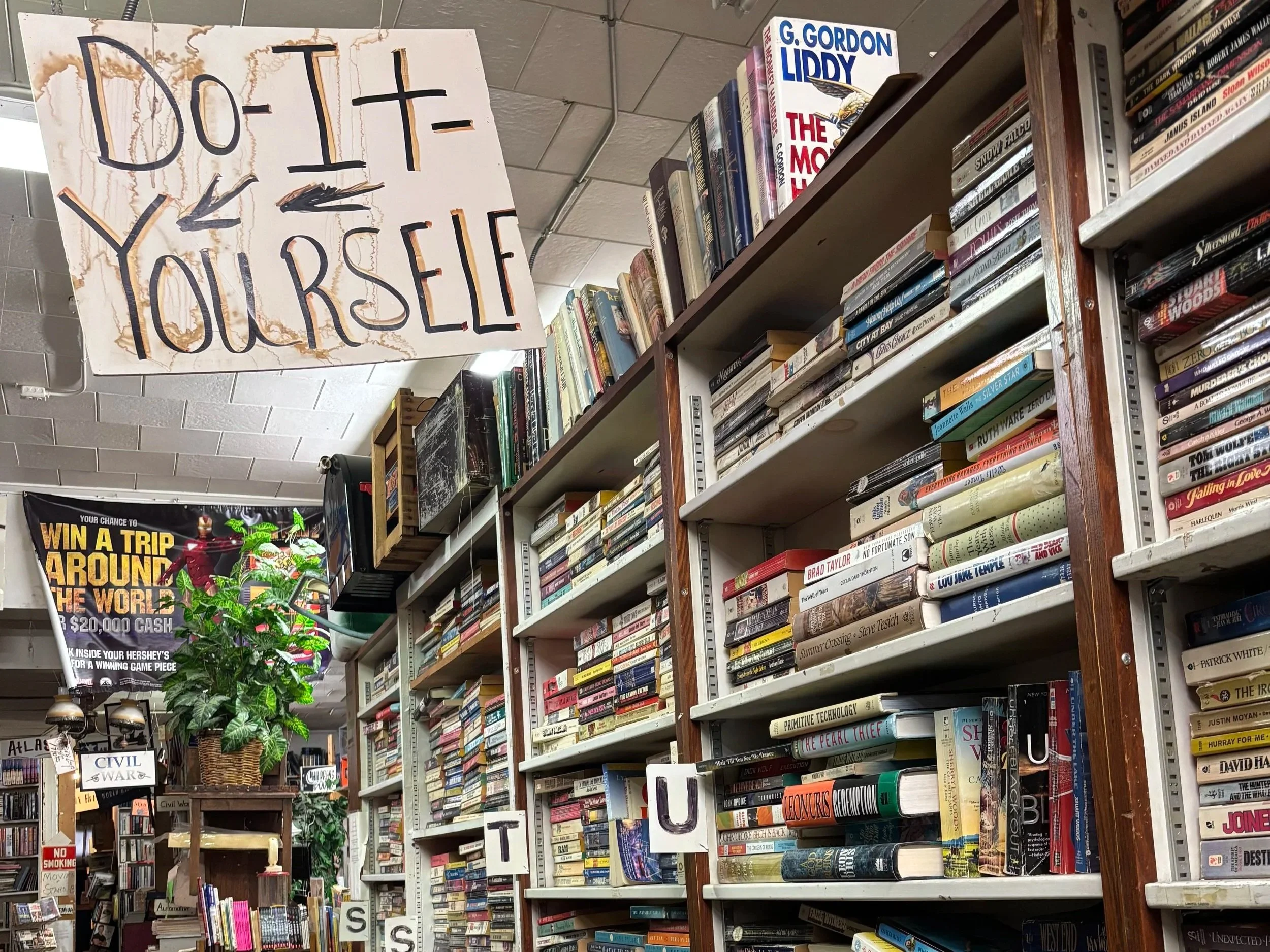
Utah Book and Magazine © John Bills
Either way, the bookshop was fucking ridiculous. There were books everywhere, and not a smidge of organisation to be seen. How the heck does anyone find a book in here? I started thinking that as soon as I entered, and the feeling grew with every step. In fact, I refuse to believe that they’ve ever sold a book. How could anyone find what they were looking for in there? I wandered aimlessly around the shop, meekly pawing at dusty books and wondering if I’d spent enough time inside to justify leaving, before deciding I had. I said thanks to the woman, nodded toward the cadaver, and left. The nostalgic and romantic could look at it as a living museum, a window into a different time, one before inventories, information, and the internet. To me, it looked like a mess. I sat with a coffee nearby and perused some reviews, some giving five stars and saying that “you could spend hours in there,” with others saying the “owners were as sweet as could be.” There were one-star reviews, with some saying they had never felt more uncomfortable in a shop. Many reviews say the place reeks of cigarettes. Others say it has a warm, tobacco smell. There is no right, there is no wrong.
Before entering the weird and wonderful world of Utah Book & Magazine, I had spent the morning in and around the weird and wonderful but in a different way world of the Church of Jesus Christ of Latter-day Saints, or, as the world knows it, the Mormon Church. Church of Jesus Christ of Latter-day Saints doesn’t even make grammatical sense, does it? I’m the writer, I should know.
But before entering the weird and wonderful world of Utah Book & Magazine and the weird and wonderful but in a different way world of the Mormons, getting to Salt Lake City had been a fucking nightmare. Long story short (I’m already 750 words into this, you see), a delayed flight from Vegas became a cancelled flight, leading to panic-booking another flight from the City of Sun, which in turn was delayed for hours. What happens in Vegas, stays in Vegas, but all I wanted to do was leave. By the time I collapsed onto my hotel bed in the City of Saints, the clock was flirting with 3 a.m.
I usually get up around 4 or 5 in the morning.
So I wasn’t in the most chipper of spirits as I wandered from the Crystal Inn Hotel & Suites towards the Pioneer Memorial Museum. I was also fucking knackered. Downtown Salt Lake City didn’t seem all that different to downtown anywhere else in the United States, so I didn’t catch my steps. The Pioneer Memorial Museum seemed like the right place to start, as much because it was as far north as I was going in the city; the Capitol was nearby. Conserve your energy, folks.
I entered the Pioneer Memorial Museum (run by the Daughters of Utah Pioneers, if you were curious), exchanged pleasantries with the gaggle of middle-aged women at the entrance, and soon found myself in what might have been the most jam-packed museum I had ever seen. The main building covered four floors, a connected carriage house brought two more, and it looked like every damn inch of wall and floor space was given over to something. Without wanting to diminish the lives of the desperate and hopeful, the Pioneer Memorial Museum was essentially a vast collection of stuff connected to the men, women, and children who settled the Utah Territory during the pioneer period. Clothes, furniture, household objects, tools, documents, toy figures made out of fruit, and almost everything else, including more portraits than you can shake a stick at, if you are in the business of shaking sticks at portraits. Some objects had stories attached, others did their talking in whispers, but the sheer number of artefacts made for a puzzling experience. It’s the notes you don't play, after all.
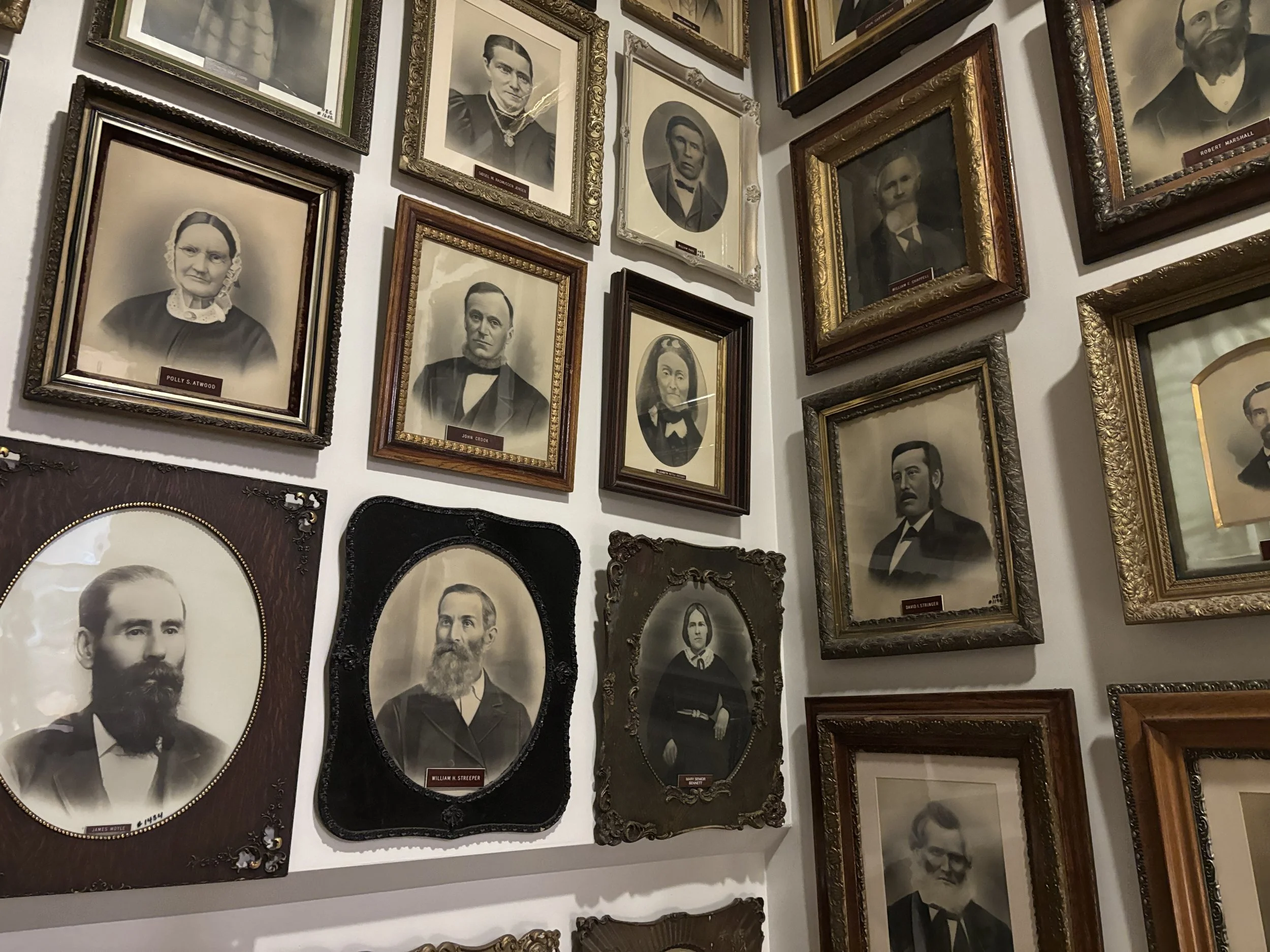
Portraits at the Pioneer Memorial Museum © John Bills
The grand version of the Mormon migration is all about wagons, deserts, persecution, revelation, and the imposing figure of Brigham Young defiantly pointing west to a promised land where lives could be lived in peace. The same can be said for America’s Westward Expansion, or the very arrival of Europeans in the Americas in the first place. The story that survives is one of strength and wonder, of unbelievable achievement in the face of seemingly insurmountable odds. Manifest Destiny, and all that jazz. For the most part, America’s expansion into the West is depicted as one of resolve, defiance, and skill. Lewis and Clark, James K. Polk, Frémont, and the rest, going where no (white) man had been before. Brigham Young and his carriage.
Now, I have neither the intelligence nor the word count to dive deep into that idea. It’s getting late, and I need to cook dinner. Still, as I wandered aimlessly around the Pioneer Memorial Museum, the understanding was hammered home that human history is not about grand success, but instead the experiences of ordinary people. The spoons they used. The toys they played with. The tools that broke, the furniture that wore out. Tough people finding a way to survive in a tough world. It isn’t heroic, and it certainly isn’t simple, but they found a way.
If you like, you can draw a line to Utah Book & Magazine. That wacky shop didn’t seem to have a chance, but it was still there. As far as I know, it is still there today.
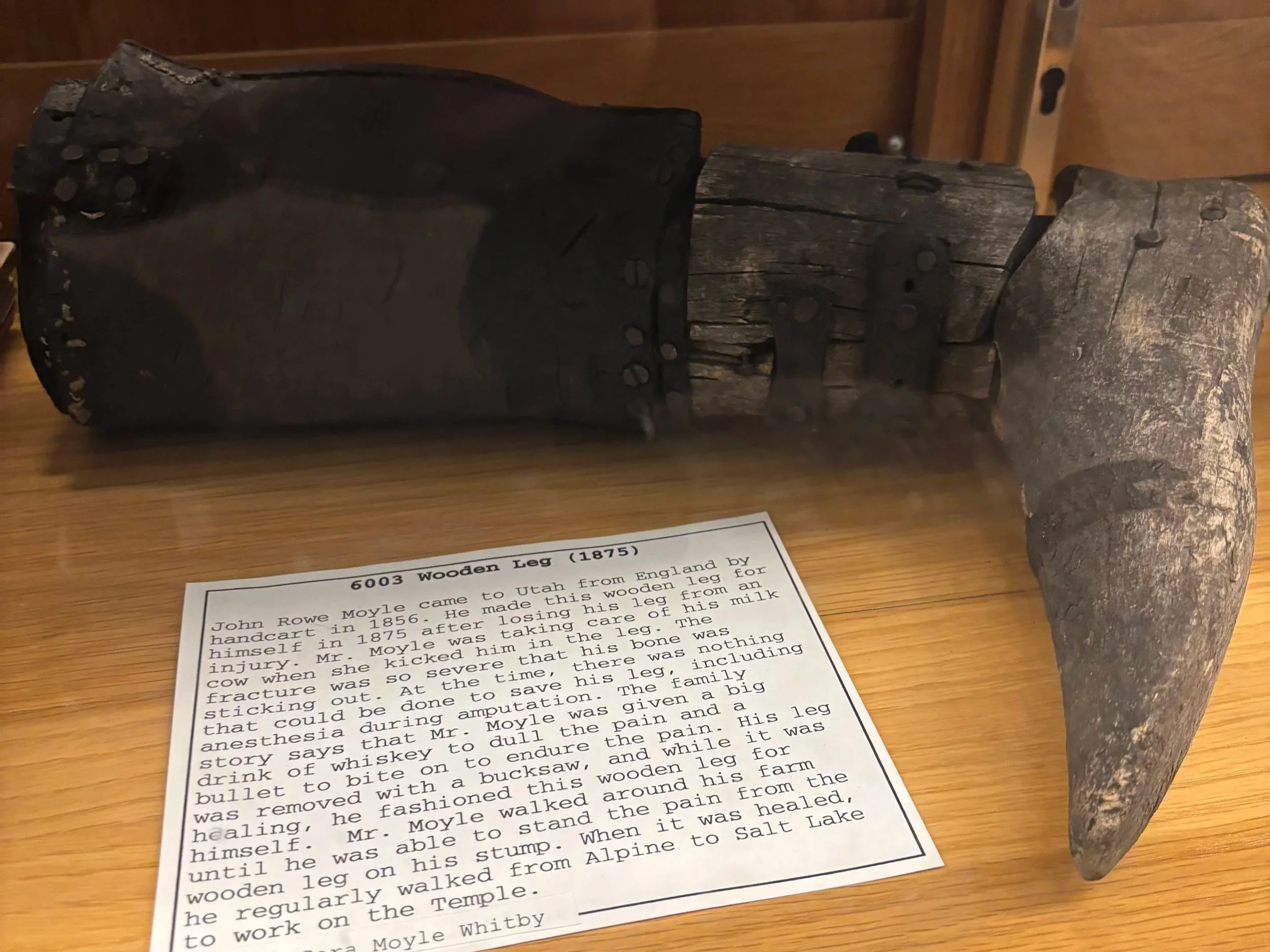
John Moyle’s wooden leg © John Bills
And that, my dear Ćabi, is why I am unable to tell the story of the Mormons in a way that even flirts with educational. I knew this, we all do, but a visit to the Pioneer Memorial Museum further inked its certainty into my brain. You can’t learn about history by studying “Great Men.” You learn about history by taking a moment to reflect on the fate of individuals like John Rowe Moyle, whose story was pointed out to me by a member of staff at the museum. In a seemingly endless collection, you need something serious to stand out.
“John Rowe Moyle came to Utah from England by handcart in 1856. He made this wooden leg for himself in 1875 after losing his leg from an injury. Mr. Moyle was taking care of his milk cow when she kicked him in the leg. The fracture was so severe that his bone was sticking out. At the time, there was nothing that could be done to save his leg, including anaesthesia during amputation. The family story says that Mr Moyle was given a big drink of whiskey to dull the pain and a bullet to bite on to endure the pain. His leg was removed with a bucksaw, and while it was healing, he fashioned this wooden leg for himself. Mr Moyle walked around his farm until he was able to stand the pain from the wooden leg on his stump. When it was healed, he regularly walked from Alpine to Salt Lake to work on the Temple.”
I don’t really know what to add to that. I mean, the leg was darn impressive, I’ll give Moyle that, but holy shit. I’m a bit tired because I went to the gym yesterday. They won’t write history books about me, but they don’t write them about John Rowe Moyle either. But I implore you: history is other people. Life is other people. Any attempt to understand the complexity of Mormon history had been shattered by a wooden leg. I stopped to look at the various Welsh artefacts included in the Pioneer Memorial Museum before leaving. Try harder, Bills.