Gimli // I Guess I’ll Just Slip It
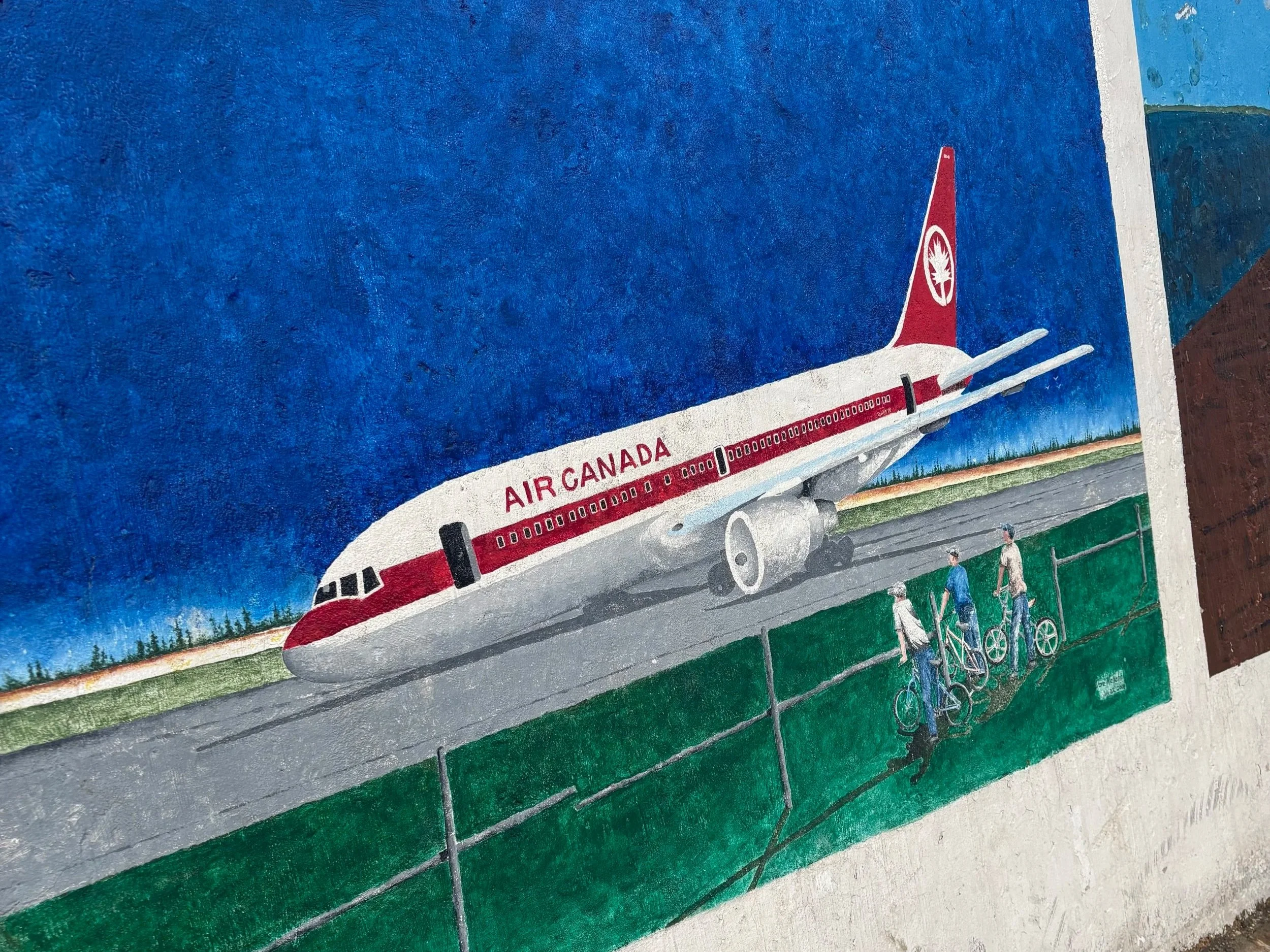
Gimli Glider mural in Gimli, Manitoba © John Bills
Love is not a decision. It is a feeling.
Yes, we’re recycling references again, but at least we’re using them in a different context. It had been a successful day in Winnipeg, the latest in a long line of good days on a North America trip that I had never truly believed would happen. A long morning walk in the sun set the tone, before we watched the Winnipeg Jets defeat Western Conference rivals the Los Angeles Kings 2-1, the highlight being Jets fans chanting “kill” whenever the home team found itself on the wrong end of a power play. These are the nicest people on the planet, and those stereotypes are true, which makes the chant all the more entertaining. I met some excellent people, drank a healthy amount of beer, and had an excellent time. Winnipeg, you are alright in my book.
The best was yet to come.

Good boys at the Jets game © Jordan Funk
That isn’t entirely true, and it is a little dismissive of Winnipeg to make the claim. The Peg had been a complete triumph, built around seeing Jordan Funk and Nicholas Rempel for the first time in 12 years. I had met the two boys from Niverville (home of Western Canada’s first grain elevator, I’ll have you know) in Belgrade during that hallowed summer of 2013, and we’d somehow managed to keep in touch in the decade that followed. I’d threatened to visit Winnipeg (25 miles or so north of Niverville) many times, and it finally happened. Good things come to those who dilly-dally for a decade before embarking on a quest to visit every city with an active NHL team, as the old saying goes. Now, we were headed to Gimli, so I could see the scene of the very best episode of Air Crash Investigation. If you love something, love it. Don’t love wisely; love well.
Funk and Rempel will get their own text in time, I assure you, and they will continue to feature prominently in this one, but the real star of this show was a man named Robert Pearson. Well, Captain Bob Pearson, to be exact, along with First Officer Maurice Quintal, with a special doff of the cap to Ron Hewett, the air traffic controller on duty.
A native of the beautiful city of Montreal, Pearson developed a love for flying from an early age, a curiosity that blossomed into a career. The specifics are blurry, but young Bob knew that he wanted to be a pilot, and would do anything to achieve that dream. He worked in Labrador to earn enough money for a private pilot’s licence, and a commercial licence followed, but he buttressed (an important word) his work with other skills, becoming an accomplished glider pilot, flying ski planes, and the rest. The man from Montreal flew large planes for work, but gliding aircraft was his passion. Pearson didn’t just like flying; he loved it. Loved with a capital LOVED, to the point of being a total nerd about it.
Also a Quebec native, Quintal came to Air Canada via a different route. Quintal served in the Royal Canadian Air Force, with a notable stint stationed at the military base in Gimli, just under 60 miles north of Winnipeg. It was an unlikely place to spend part of a military career, but it meant Quintal knew the airfield. Hewett? He was from Winnipeg, but grew up on the family farm at Oak Bluff, 12 miles southwest of the city. Hewett was a man of many skills; a mechanic and an athlete, he was as comfortable under the wheels of a car as on the baseball field. Hewett was eventually inducted into the Manitoba Baseball Hall of Fame in 2005, but it was the former that paid his bills, working as a mechanic for Air Canada before moving into air traffic control. Pearson, Quintal, Hewett. Three individuals living passionate lives, destined to come together to produce a miracle.
There was nothing miraculous about the drive north from Winnipeg to Gimli on that increasingly cloudy October afternoon. The vibes were good, the conversation flowed, a reminder, if such things were needed, that good people are eternal. The drive took us through seemingly endless farmland as flat as the proverbial pancake, plain prairie that stretched for a lifetime.
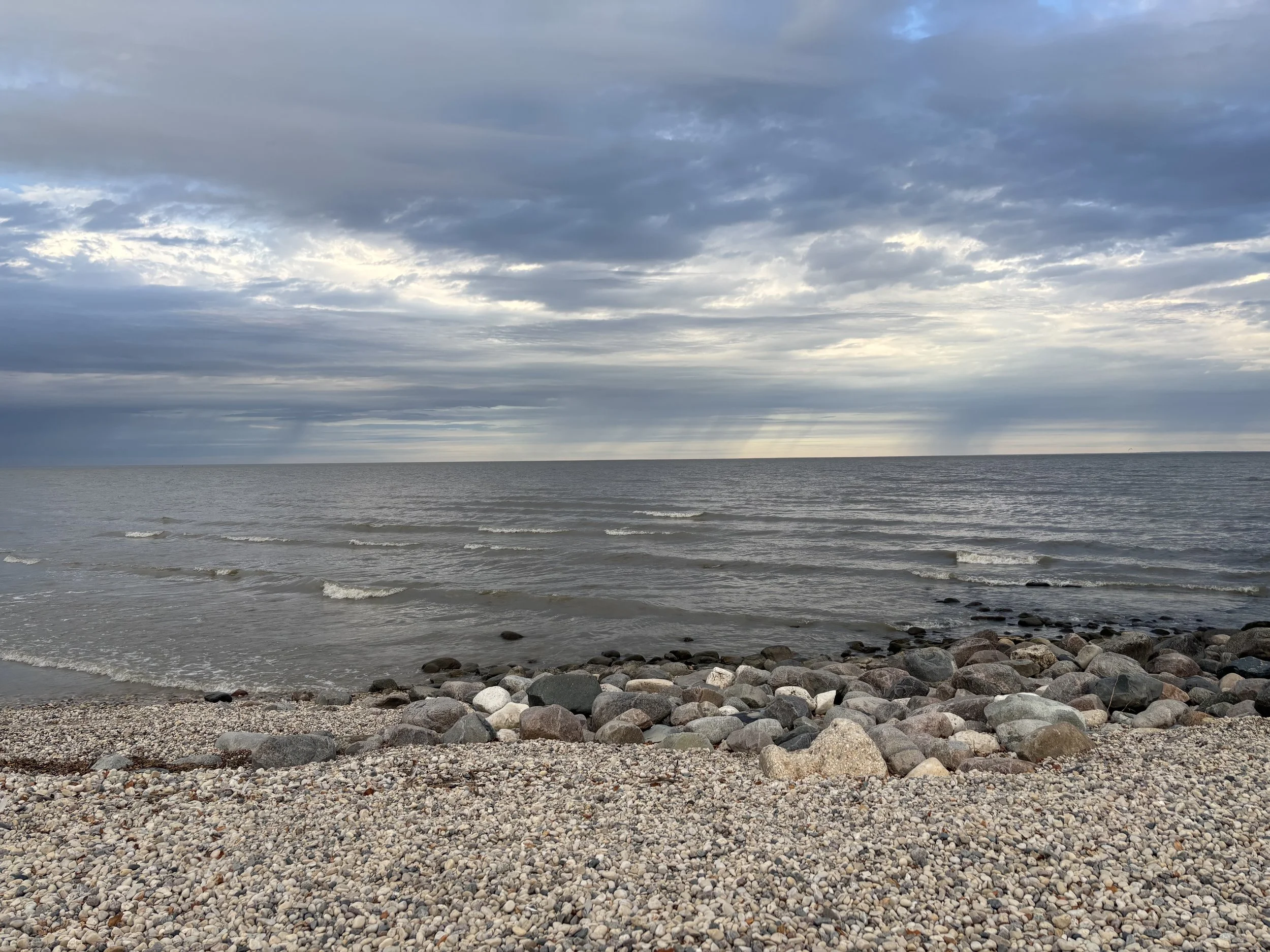
Lake Winnipeg in Gimli © John Bills
As ever, my mind wandered to the first settlers who encountered this place and conjured up the courage to explore. What was going through their minds? Were they utterly fearless, or completely terrified of every single thing, every step of the way? Gimli sits on the western shore of Lake Winnipeg, and its history is defined by Icelandic settlers. Yes, Icelandic. From Iceland (not the supermarket). How? Another one of those miracles created by will, I suppose. The first permanent Icelandic settlers arrived at nearby Willow Point in October 1875, an initial group of around 200 that grew to 1,200 within a year. The name? Gimli comes from the Icelandic form of Gimlé, a place in Nordic mythology where the survivors of Ragnarök called home. They say it is the most beautiful place on Earth, but the early settlers could be forgiven for thinking otherwise. This was a harsh place, where brutal winters and poor agricultural conditions made for tough living and tough people. The arrival of the railway at the start of the 20th century changed everything, as it tends to, turning Gimli into a summer resort for Winnipeggers, but it remains the centre of the largest Icelandic community outside of Iceland.
I can’t imagine the Land of Fire and Ice was on Pearson and Quintal's minds as they took off from Montreal on July 23, 1983. The flight was headed to Edmonton (with a stop in Ottawa), carrying 61 passengers alongside eight crew, and everything was running smoothly. Pearson and Quintal had flown together a few times and got on well, although Bob Pearson was very much the type to get on with everyone. Pearson had even helped Quintal out of a jam earlier in his career, when there was an issue with a registration. The two had a good rapport. Paul Jennings was down to be the First Officer on Flight 143, but had fallen ill, with Quintal down as standby.
And everything was going fine, but the very existence of this article suggests that things did not stay that way. Sure enough, as the plane flew over northern Manitoba, the problems began to pile up. Warnings sounded, suggesting that this sophisticated piece of modern machinery needed a human hand. Another warning sounded. Pearson disengaged the autopilot and took control, but the issues continued. Before long, the fuel was exhausted. The left engine went, soon followed by the right. Seemingly out of nowhere, this humongous plane was out of fuel. No fuel means no engines, no generators, no computers. For all intents and purposes, it was now a massive box full of people in the sky.
Well, bugger.
How? Well, the problem was almost hilariously mundane. Canada was switching to metric measurements, and Flight 143’s fuel quantity had to be calculated manually. The wrong conversion from pounds to kilograms was used, and nobody thought to question it. As I once read, they were talking about pounds, but thought they were talking about kilograms. The plane took off with less than half the fuel it required.
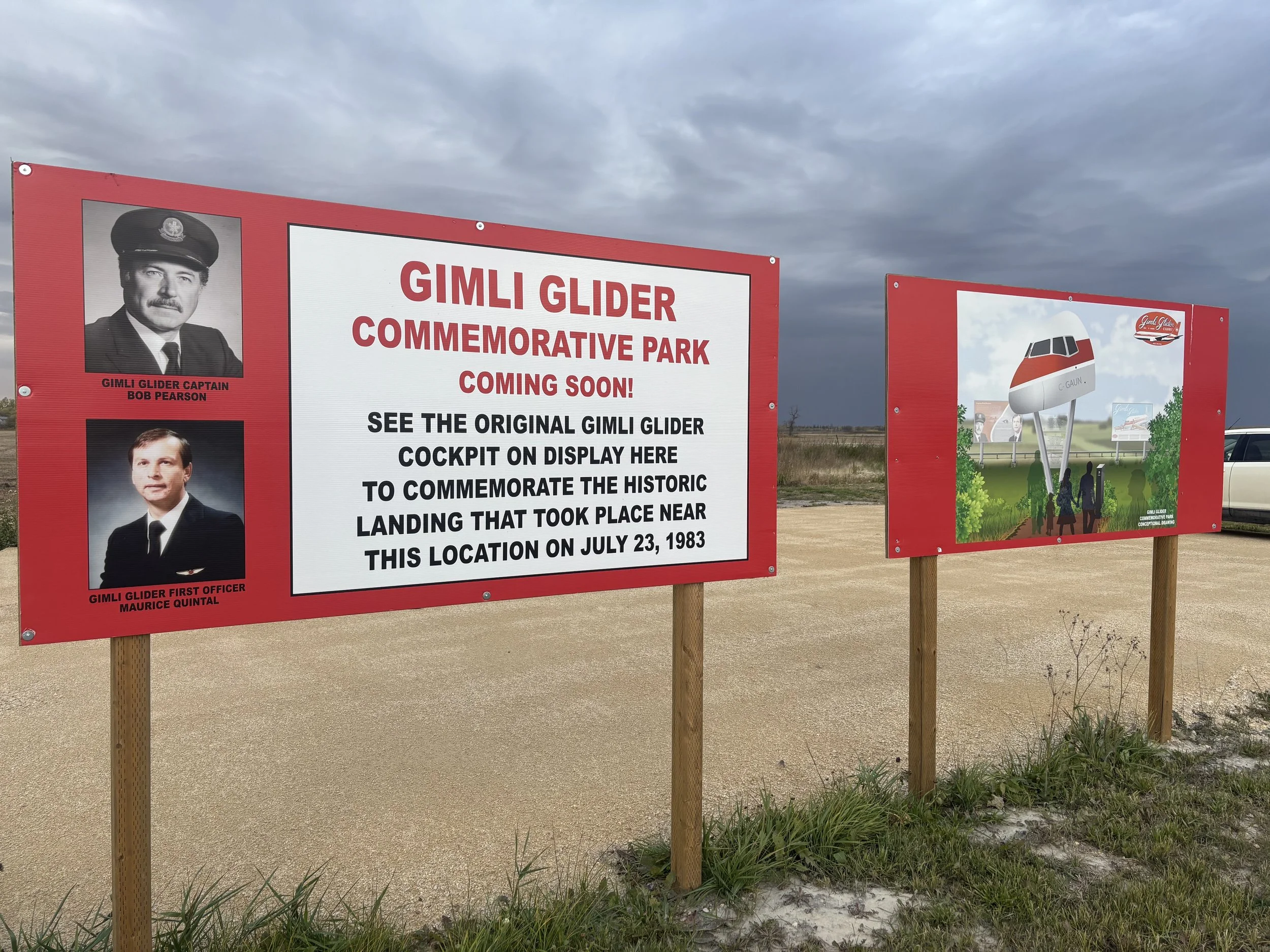
Gimli Glider Commemorative Park Promise © John Bills
While it is somewhat frustrating to disappoint once more, it would be foolish of me to pretend that I can give a detailed account of what happened. I can’t. I have watched the Gimli Glider episode countless times, read articles and books, and devoured as much media about the event as I can find, yet the capacity to do it justice remains out of my grasp. The plane was in the sky, but it had no fuel. Now, aeroplanes are built on the principle of redundancy, the idea that these incredibly complex machines are never truly working at 100%. There are backups for everything, but most of those backups require fuel. At this point, Captain Bob Pearson and First Officer Maurice Quintal were essentially flying with nothing more than a magnetic compass, an artificial horizon indicator, an airspeed indicator, an altimeter, their combined years of experience, and hope. Far from ideal, I’m sure you’ll agree. Over at Winnipeg ATC, Ron Hewett gave them all he could, but you don’t need me to reiterate that it was limited.
Pearson was optimistic about making it to Winnipeg, but Quintal’s calculations suggested they would fall about 12 miles short. Again, let’s not pretend that they assumed a safe landing; Winnipeg was ideal because of the relative abundance of emergency services in the case of an accident. All well and good, but they weren’t getting to Winnipeg. The decision was made to try Gimli.
You know, where Maurice Quintal served in the military.
From here, the story transcends into the scarcely believable, fast becoming the Chris Parnell of the skies. The plane had no fuel and next to no computer control, and Pearson saw only one option; he had to use his gliding skills and find a way to side-slip this massive plane to the ground. He pulled the yoke to the left and smashed his foot against the right pedal, meaning the plane side-shimmied its way towards the ground, not unlike a surfer trying to maintain balance on waves. Well, a surfer travelling at 220 knots (250 mph, there or thereabouts). The landing gear was lowered, failed initially, but locked into place on the second go, with the exception of the nose gear. They were just going to have to deal with that. At least they had a long, abandoned runway to work with.

Winnipeg Sports Car Club in Gimli © John Bills
Except the runway wasn’t abandoned. On that fateful July day, it was being used by the Winnipeg Sports Car Club, who were having a jolly old day, enjoying some races, barbecues, and beers. Three kids had taken to the old runway on their bikes, utterly oblivious to the humongous aeroplane coming in fast. Miraculously, the plane touched down (blowing two tyres on landing), the nose scraping violently along the ground, the entire behemoth hurtling down the runway until a low metal guardrail provided some resistance. Somehow, the Gimli Glider had made it to the ground, and the only injuries came from folks going down the emergency slide in the evacuation that followed. A miracle.
And just like that, we were there. Gimli Industrial Park Airport, now home to Gimli Motorsports Park, surrounded by that jarringly modern mix of anonymous warehouses and endless prairie. We are an indecisive people, a state of affairs rendered inevitable by an abundance of choice and a dearth of necessity. Purple prose, buddy, and largely unnecessary for setting this scene, but possibly useful in its own way. After all, there wasn’t really anything to the scene. An abandoned runway, a race track with a collection of vehicles doing seemingly random laps, the threat of rain, and the giddy joy of standing on the spot where Captain Bob Pearson and First Officer Maurice Quintal pulled off the seemingly impossible.
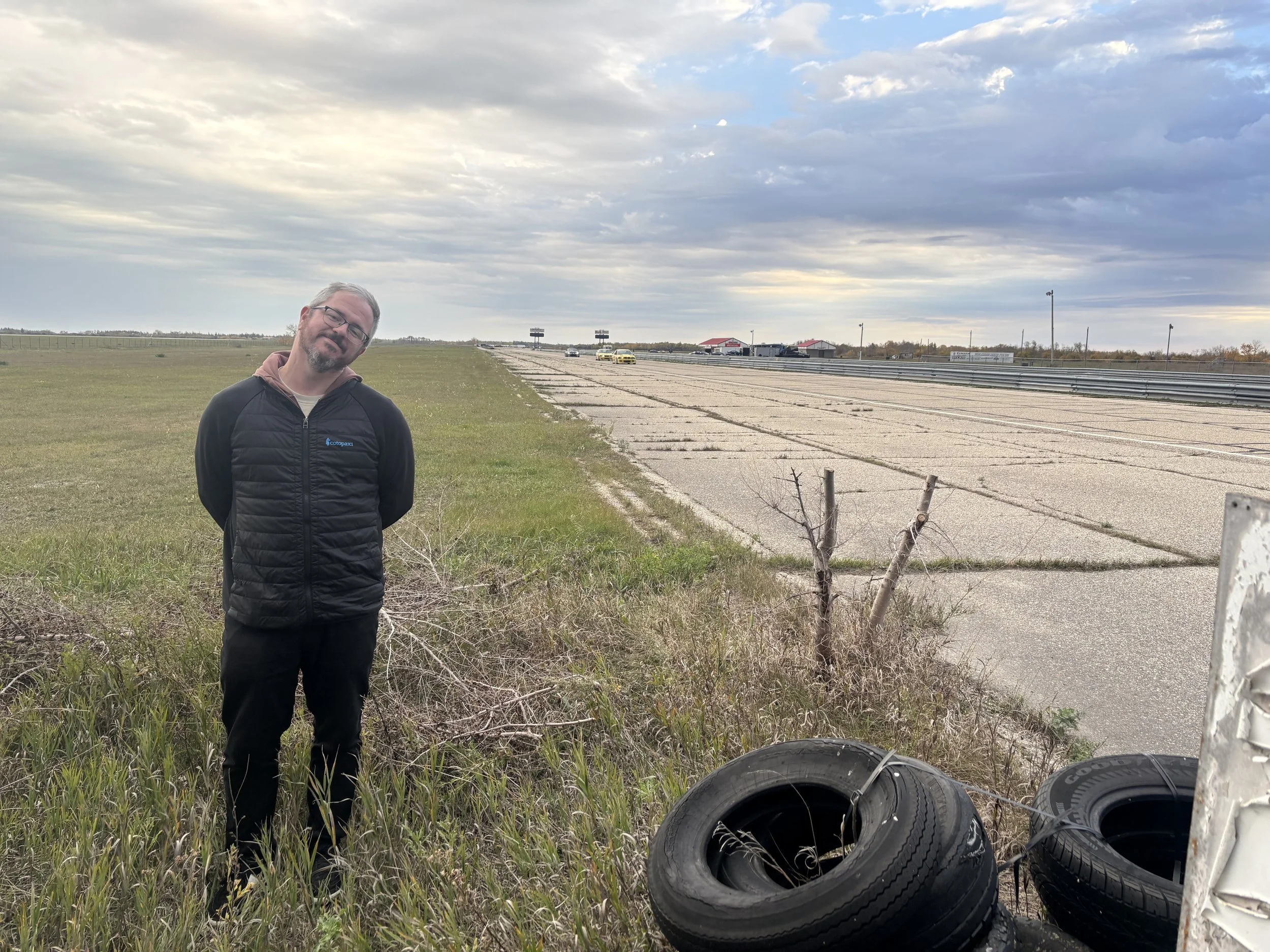
Shlump at Gimli © John Bills
For many, the quest for the meaning of life is suffocating. I will accept that I am among those gasping for air, despite the answer being presented to me in language I understand on an almost comically frequent basis. There is no singular meaning to it all. Ultimately, life shines brightest in exhilarating moments of joy (see Dobrinja, a pair of socks, an umbrella, a copy of Invisible Cities) and the willingness of the individual to run wild with the things they enjoy. For whatever reason, I enjoy Air Crash Investigation. For very clear reasons, the Gimli Glider episode is my favourite. Here I was, at Gimli Industrial Park Airport, some 3,725 miles from the town in which I was born and will inevitably die, taking it all in. I had been brought here by two magnificent human beings, two fully formed, fabulous men who came into my life through sheer luck, for all intents and purposes disappeared for over a decade, and then reappeared, driving me the 55 miles to Gimli and then 55 miles back to Winnipeg. The Gimli Glider was the reason I was interested in coming here, but Nick and Jordan, two blokes from Manitoba who cared about me enough to indulge my weird interests, were the literal reason that I had made it to Gimli. Zoom out a little further, and I was 24 cities into a quest to visit every destination with an active NHL team. A boy from Mid Wales, where ice hockey isn’t a thing, two-thirds of the way through a trip that existed on the fringes of sanity for so very long. If this isn’t living, what is? If you can’t find meaning in the miracle of Gimli and passionately loving the things you enjoy, then that’s on you. The world isn’t going to do all of the work.
Miracles do happen, I assure you, and Gimli is proof of this. Maybe not to you, maybe not to most, but the story of the Gimli Glider and my eventual visit are all I need to convince myself that there is a chance. If any other two men had been in the cockpit of Air Canada Flight 143, there’s a better than even chance that 69 people would have died on July 23, 1983. Pearson’s love of gliding didn’t bring him into this cockpit in a mystical, predetermined sense. Quintal’s time at Gimli wasn’t the universe preparing him for the job. Paul Jennings hadn’t fallen ill so that Maurice Quintal could sit in the cockpit that day. Hewett’s personality and experiences weren’t part of an application to help save Air Canada Flight 143. This wasn’t destiny, but all three men had spent years accumulating knowledge fuelled by love, and on one extraordinary afternoon that knowledge converged. We are allowed to find meaning in the coincidental.
Butterflies and hurricanes and all that, but this is my article, and the power of hope should always take priority over literal fact. We aren’t here for the literal. True words are not beautiful, and beautiful words are not true. The Lifespan of a Fact, buddy.