Graz // Milk is for Babies
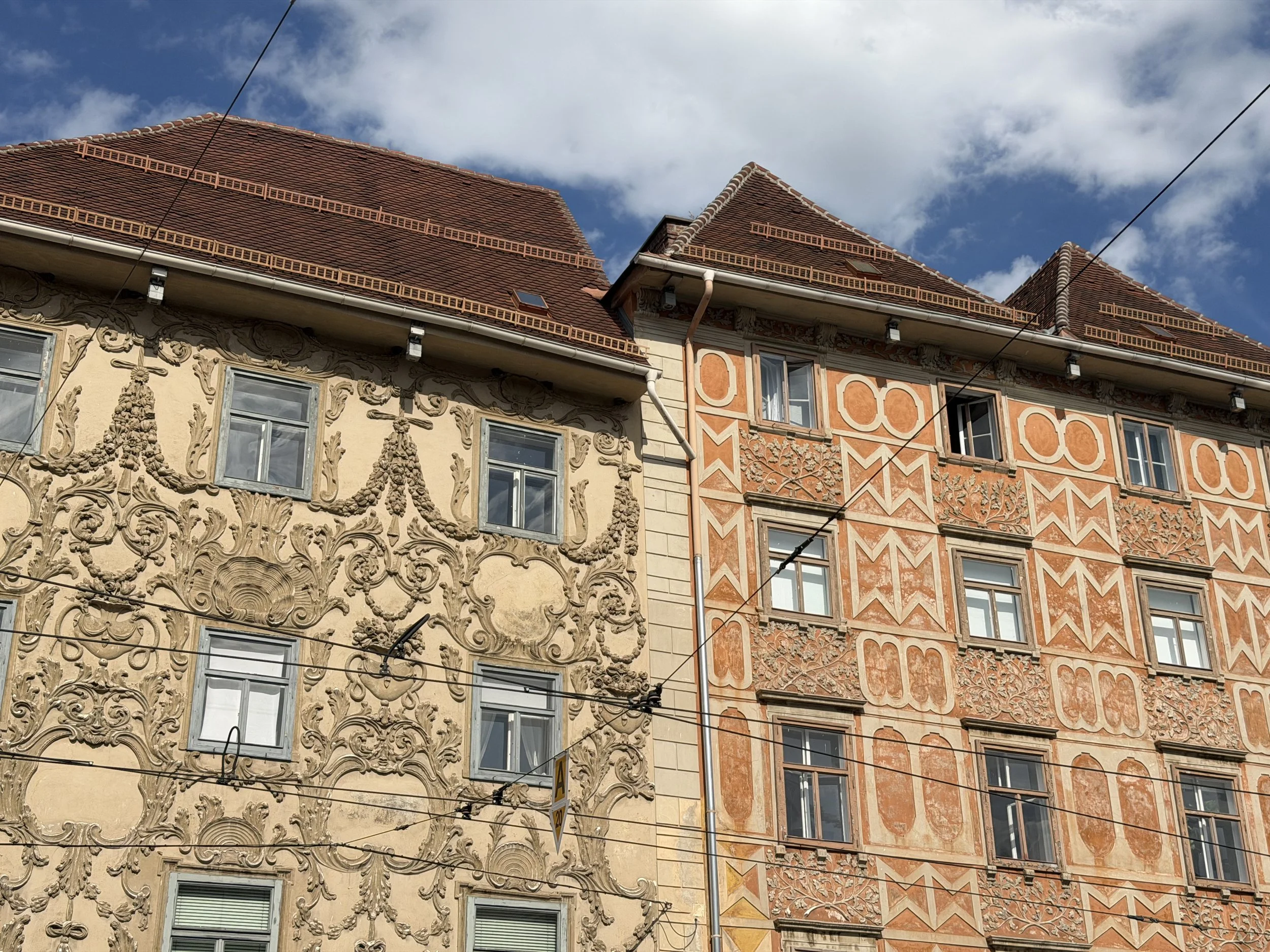
The Luegghaus in Graz © John Bills
My first impression of Graz was that it was a little scuzzier than I expected. Now, now, I know, first impressions aren’t really worth much. Your first impression of me wasn’t the best, and I no longer know whether that initial opinion was vindicated, but I still cling to the idea that it wasn’t. Graz? Unexpectedly scuzzy. Blame it on the train station, if you must, as almost all European train stations are seemingly surrounded by a sketchy air and tired faces. Austria’s second largest city was no different. My hotel happened to be right next to the train station, although the use of the word “happened” feels a little out of place. None of this just “happens.” There is thought behind every muscle moved.
But yeah, Graz, weirdly scuzzy. I dropped off Horse and ventured out, lacking a plan but brimming with the optimism that comes with the aimless wander. You never know what you might see, right? Graz is known for its remarkably well-preserved medieval city centre, a status acknowledged by none other than UNESCO, the grand Politburo of tourism. If the junta gives it the thumbs-up, it must be worth your attention, but comparing UNESCO to a shady dictatorship suggests it might be time for me to hang up my boots. All of these paragraphs are still the same length. All travel writers are liars. Tell my imaginary wife that I am sorry. Etcetera, etcetera.
My steps brought me closer to that cabal-approved city centre, and it was difficult to dispute its status. The first real indication comes with the bridges that cross the Mur, its leafy banks topped by the upper floors and roofs of exquisite structures, classical Austrian architecture straight from the textbooks. Those Habsburgs weren’t all bad, right? There is something about the architecture of Central Europe that sings to the soul, and the heart of Graz was overflowing with the stuff. I continued wandering but soon decided to make a beeline for the cathedral, allowing me to do a circle of sorts before my legs waved the white flag. Graz Cathedral is a stunner, a 15th-century late-Gothic beauty built under the auspices of Friedrich Three, a bloke who had a 53-year run as Holy Roman Emperor between 1452 and 1493. He wasn’t lacking in confidence, as the 1460 fresco of St. Christopher inside suggests, what with it taking Fred’s face and all. The cathedral was beautiful, the stubborn and secretive Friedrich Three less so, a man whose prevailing attribute was simply an ability to live longer than other people. The fascinating Gottesplagenbild was arguably the most interesting aspect, a 15th-century fresco depicting the horrors of that time. Plague, locusts, invaders, the lot. It’s today, three hours from now. There’s only so much one can take.
My steps curved to the left, passing the oldest bakery in the city, Hofbäckerei Edegger-Tax, first mentioned in the 16th century but probably older, and bringing me onto the winsome Sporgasse, a street older than the city it serves. The highlight of the Sporgasse was the Luegghaus, a stunning 17th-century building with a stucco facade that lives long in the memory, striking in all the best ways. From there, any walk through the heart of Graz thrusts the Habsburg years to the fore, inspiring wistful sighs and words of appreciation.
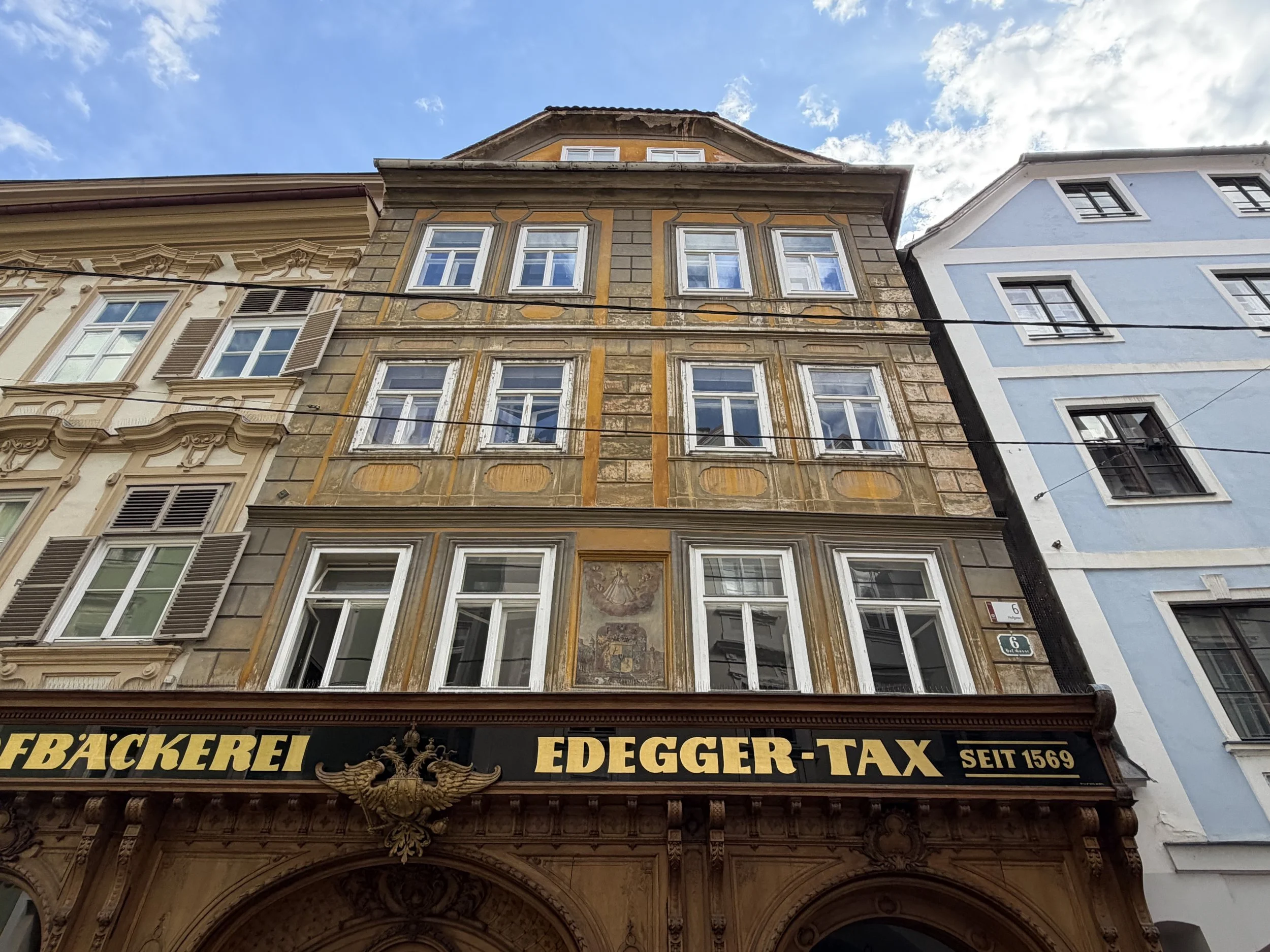
Edegger-Tax in Graz © John Bills
But let me stop you there. Far be it from me to diminish the value of the Habsburg centuries. Those years left fingerprints all across the globe, whether through architecture, food, language, culture, or war. It is important, and that cannot be denied. However, my argument today is that no single Habsburg is as important as Arnold Schwarzenegger. Maybe, just maybe, Arnie is more important to the average person than all of the Habsburgs. Combined.
You can take a moment with that.
Arnie wasn’t always Arnie. I mean, he was always Arnie, but he wasn’t Arnie. Before he conquered the world, he was a young boy in a desperately poor family coming to terms with the brutal existence of post-World War II Austria. There are limits to sympathy here, not with regard to Arnie, but his father; Gustav Schwarzenegger was a member of the Nazi Party and had served in the military during the war. For many, that is the end of the discussion. The post-war Schwarzenegger home was desperately poor, though that was true of much of Austria at the time. There was no electricity, no running water, and no indoor plumbing. Unsurprisingly, Gustav was an alcoholic. Arnold Schwarzenegger’s childhood was one of insecurity, poverty, and violence.
For many, the Habsburg Empire begins with Rudolf One, the man who became Holy Roman Emperor in 1273. Rudolf was, for all intents and purposes, born into the 1% of his time, which carried significantly more weight in the 13th century than even today. His family had been accumulating power since at least the 10th century, and from the beginning, Rudie had a noble title, land to inherit, a fortified castle, access to the imperial court, political connections, and an aristocratic family network. Quite literally, everything was in his favour.
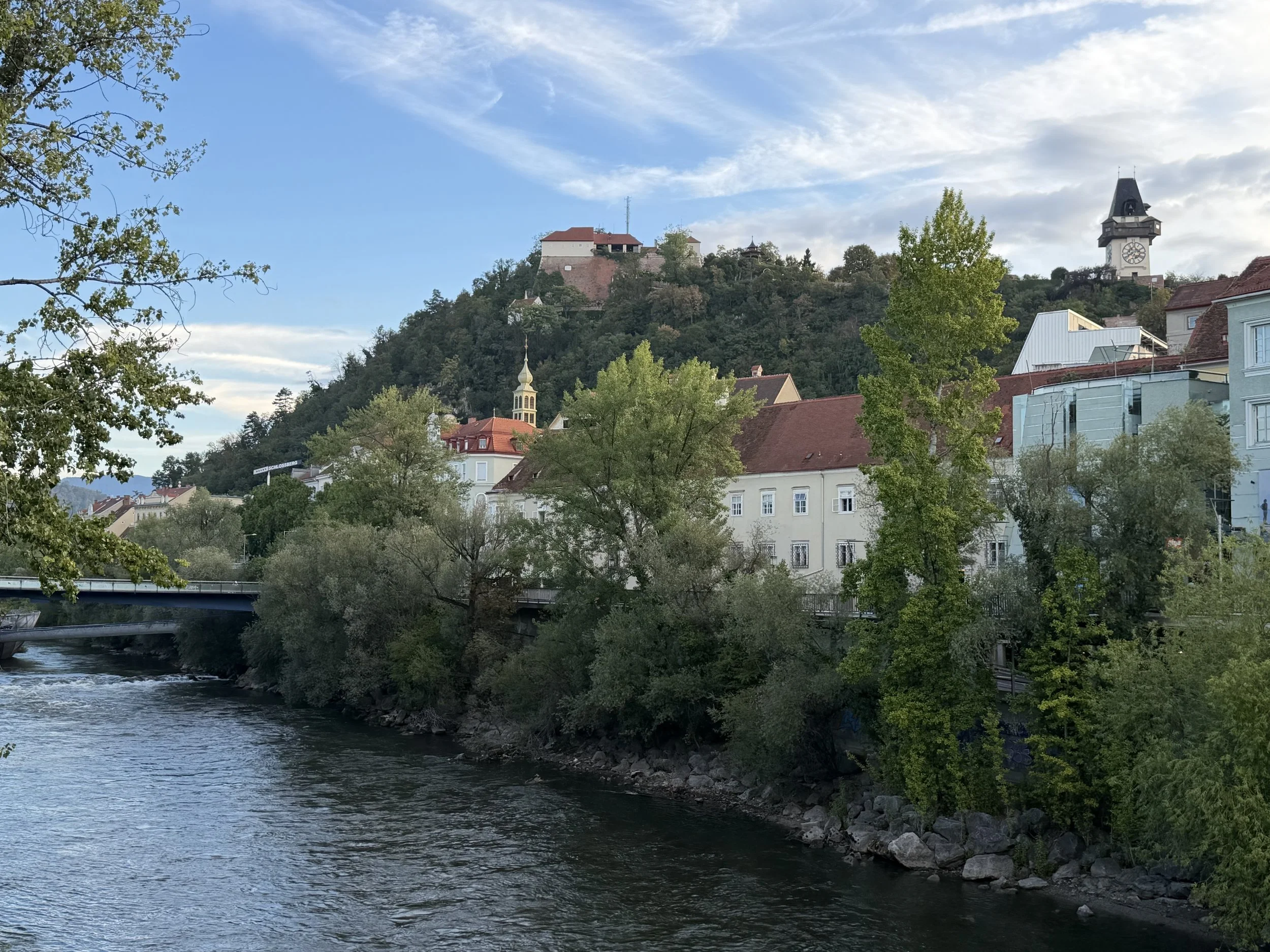
A view of Graz © John Bills
Young Arnold was born into a competitive world, and his father was said to have frequently pitted him against his older brother in various sports. By all accounts, Arnie was a decent football player, but photographs of bodybuilders like Reg Park and Steve Reeves put the young Austrian on a path that would change his world. The boy from Thal was convinced that he could transform both his body and his life through effort. He began lifting weights around 14, all the while training his brain to understand proportion, symmetry, presentation, and the rest. He went absent from the Austrian Army to compete in the Junior Mr Europe contest (he won, obviously). He won Mr Universe at the age of 20, the youngest ever winner, and ventured to America armed with little more than the most basic English, a heavy accent, and an unbreakable desire to become the world’s greatest bodybuilder. Seven Mr Olympia titles between 1970 and 1980 confirmed the latter (he remains the youngest to win the sport’s most prestigious prize), and Arnie transformed bodybuilding’s public profile in the process. Genetics helped, sure, but even the most perfect genetic makeup requires cultivation, discipline, competitive intelligence, and the ability to achieve seemingly impossible objectives. Arnie came from next to nothing, and became the world’s greatest.
By the time Maximilian One was born in 1459, the Habsburgs were already a functioning dynastic machine. Max was born a prince, and his entire existence was built towards inheriting and ruling. He had unlimited wealth and a vast territorial base that expanded after his arranged marriage to Mary of Burgundy, one of the continent’s most important heiresses. Max had a platform that allowed him to become powerful, although he was powerful by definition. Quite literally, everything was in his favour.
So, you’ve become a bodybuilding icon, arguably the most recognisable name and face in the history of the sport. What now? Hollywood, obviously, and Arnie wasn’t about to let his lack of conventional acting training or experience hold him back. His name was difficult for American audiences to pronounce, his thick accent was considered a liability by producers, and his massive physique seemed to limit the roles he could play, but obstacles are to be overcome. It wasn’t a seamless transition, and he was treated as a novelty in those early years, but the characteristics that had made Arnie the world’s greatest bodybuilder were about to help him become a household name on the big screen. He identified his weaknesses, worked tirelessly on them, and found ways to make them useful. Thick accent and hulking physique? Conan the Barbarian is the perfect role. Delivery a little robotic? Why not play an actual machine, as in The Terminator? Instead of conforming to Hollywood norms, Arnold Schwarzenegger created a new kind of screen star around himself. A willingness to poke fun at himself opened up the world of comedy, giving us magical movies like Twins and Kindergarten Cop, as the boy from an abusive, impoverished childhood in post-war Europe continued to show that anything was possible when fuelled by determination, work, and ambition.
Charles Five is arguably the most famous Habsburg ruler, and I’m willing to cut Charlie a little bit of slack on this adventure. Sure, he inherited an international superpower that included some of Europe’s most commercially developed and prosperous territories, not to mention an increasingly strong presence in the Americas, but he at least put in some hard yards and had to manage it all. I’ll give Chuck that much. Still, he was born with a path to the throne, unlimited wealth, and the world at his feet. Quite literally, everything was in his favour.
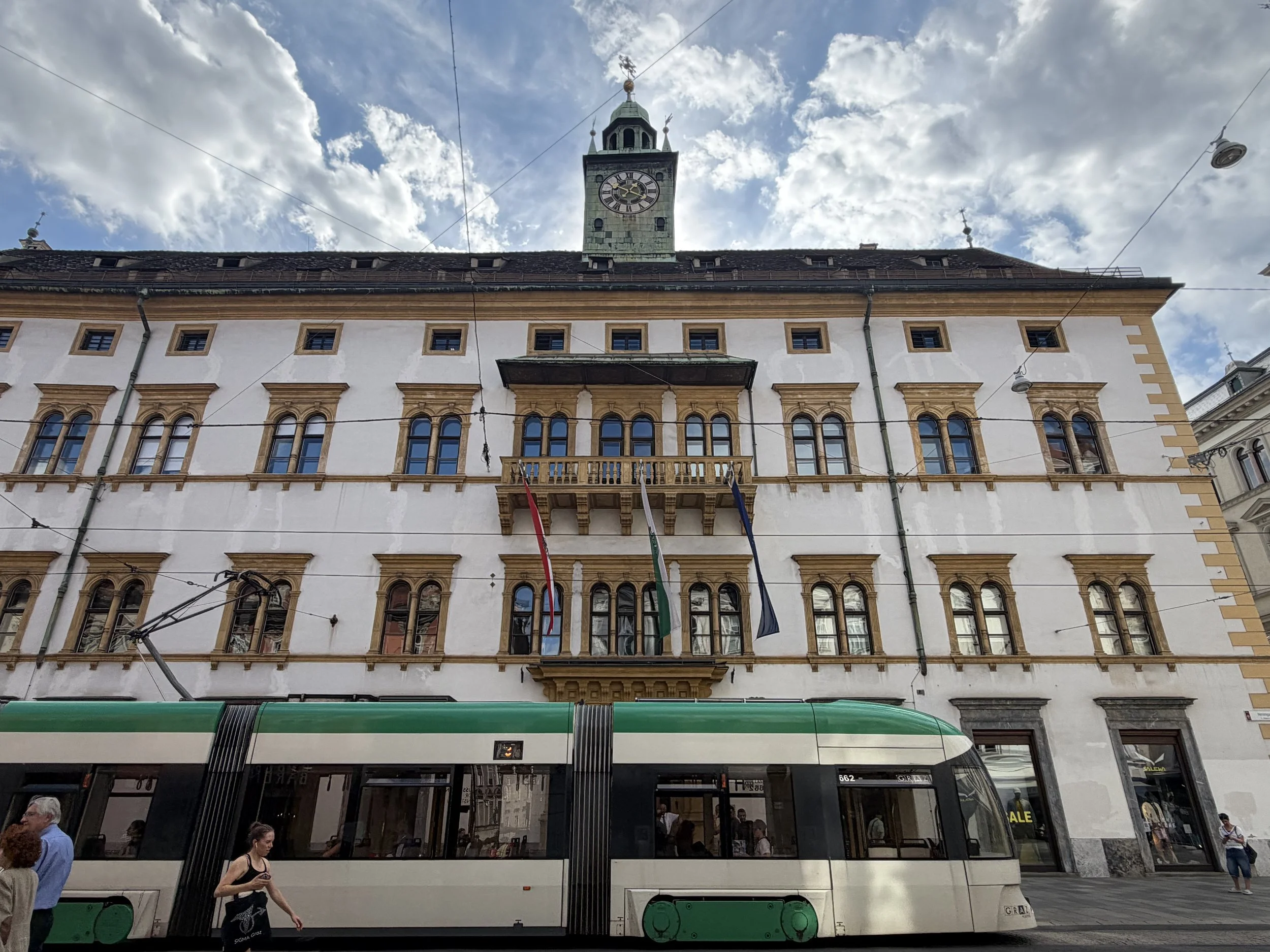
Town Hall in Graz © John Bills
Sport and cinema conquered, Arnold Schwarzenegger had become one of the most recognisable faces on the planet. You’d think a life of luxury and wealth would be enough, but the Austrian Oak was ready for a third great reinvention, one that completed his transformation from an impoverished, seemingly powerless upbringing. Politics, baby! In 2003, Schwarzenegger entered the race to become Governor of California as an outsider, but that was comfortable ground for Arnie. Riding a wave of optimism, Arnie became California’s 38th governor, winning a full term in 2006, and attempted to establish himself as a pragmatic, centrist Republican, working on infrastructure and climate policy along the way. Was it a grand success? History will decide, but we’re only interested in the contrast with those Habsburgs. The boy from a poor Austrian village eventually received a mandate from millions of strangers to exercise power, something the Habsburgs only achieved through the blind luck of birth.
And that’s just the three most notable Habsburgs. We’ve not even dipped our silver spoon into the chumps. There’s Rudolf Two, a dude born into one of history’s most powerful families who decided to spend his time collecting weird stuff (actually, that doesn’t sound so bad). There’s the neglectful party animal that was Josef One, Ferdinand Maximilian and the arrogance that led him to rule Mexico, and Matthias, who spent years scheming to take over from his brother only to fuck it all up when he did.
Now, I’m not going to sit here and claim that everything Arnie did turned to gold. I mean, Iron Mask exists, after all, but I’m still willing to stand by that wacky point made some 1,100 words ago. To the vast majority of individual human beings on the planet, Arnold Schwarzenegger is far more important and influential than any single Habsburg, more important than all of them combined, and you really should have picked up the thread at this point. The average person has more in common with Arnold Schwarzenegger, and his incredible success can be taken as proof that it is always possible to turn a life around. You don’t need to be born with riches, connections, land, castles, and you don’t need to be born with access to the imperial court. You do need to find determination, ambition, an iron will, self-respect, discipline, and an open mind.
The Habsburgs are fascinating, I’m not about to deny that. The inbreeding, the Habsburg jaw, the whole “ruled most of Europe for centuries” thing, Charles Two and his massive tongue, Leopold One’s interest in watching dwarves beat live foxes, and on and on, but they shaped borders, built cities, started and ended wars, and the rest. Well, they paid people to do those things, but let’s not quibble after 2,000 words. Fundamentally, the Habsburg story is one of privilege that 99.9% of humans simply cannot identify with. Arnie? He grew up in a poor, dysfunctional household with the understanding that nobody was coming to save him. It was up to him. There was no guarantee of anything. And no, his story is not a guarantee of anything. Sometimes, it doesn’t work out, and that’s okay, but circumstances are not destiny. You do not need to inherit an empire to build something magnificent, and you can always reinvent yourself. And no, you can’t climb the ladder of success with your hands in your pockets, and yes, milk is for babies. When you grow up, you have to drink beer.