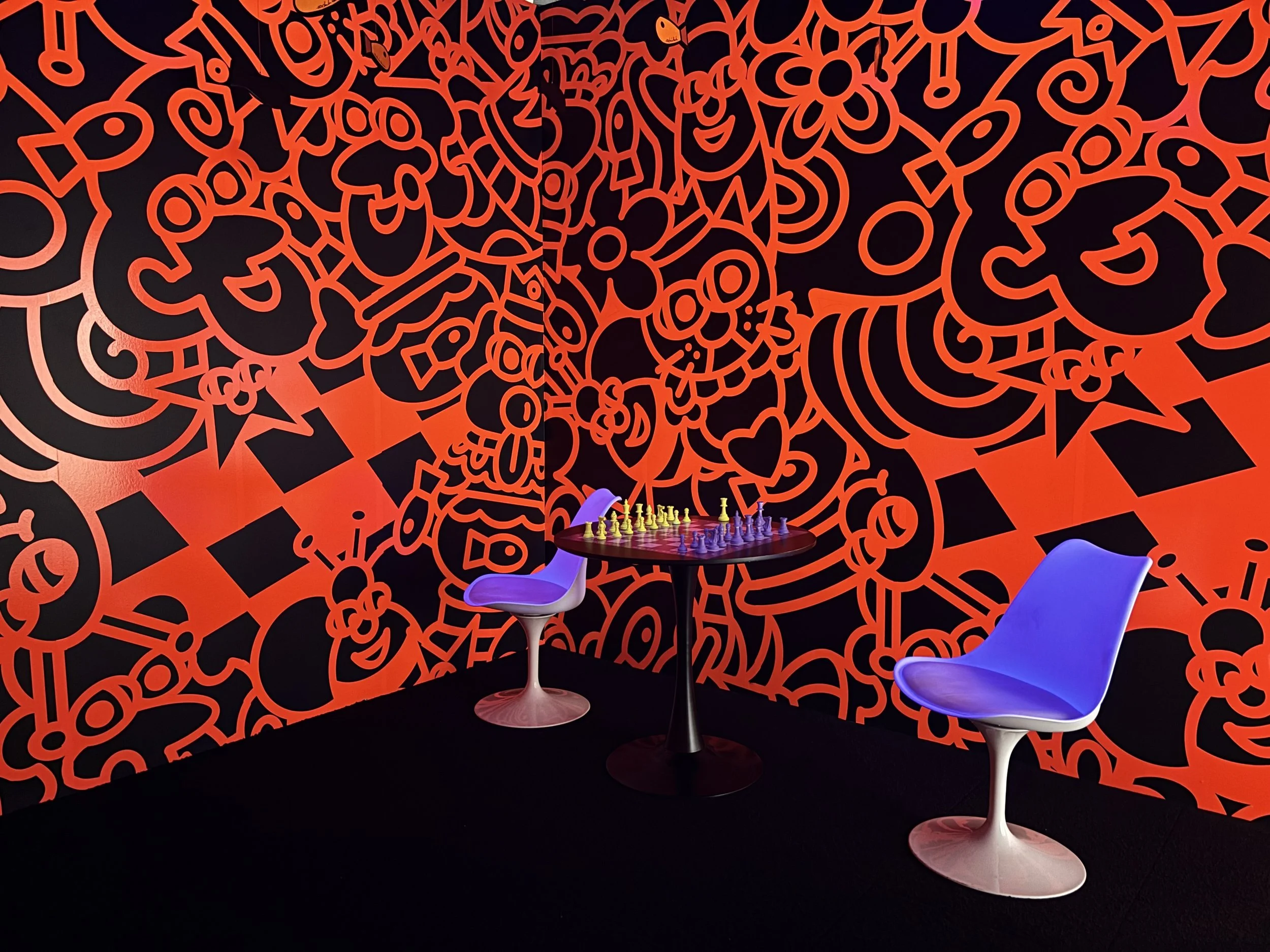
A chess set in St. Louis // © John Bills
“Did you know that I was the third best chess player in Nigeria?” No, Adetola, I did not. It struck me as a relatively easy thing to corroborate, but why bother? If Adetola the Nigerian Uber Driver wanted to regale me with tales of chess exploits in Africa’s most populous country, I should consider myself lucky and listen. Unfortunately, Adetola’s opening gambit (that’s a chess joke) wasn’t backed up with tumultuous stories of great escapes and Hail Marys. We spoke about chess, albeit in a distant sort of way, repeating basic information back and forth in an attempt to convince the other that we understood. Yes, I play, but I’m not particularly strong. I don’t have the patience to build attacks, I can’t see traps, and I usually get caught up in captures. Adetola chuckled, made a comment about beginners, and dropped me off at our pre-arranged stop in the Central West End, where a 20-foot-tall King was waiting for me.
As in the chess piece, not an actual monarch. A wacky image, but an incorrect one.
St. Louis had been a strange one. The city has a reputation, a somewhat polite way of saying that it is known as a dangerous spot, which is also a relatively polite way of saying that there are a lot of homicides in these parts. Things are improving, but they are improving from a pretty brutal nadir. I’m no sociologist, but I’m guessing concentrated neighbourhood poverty, drug trafficking, and quirks of geography have something to do with it.
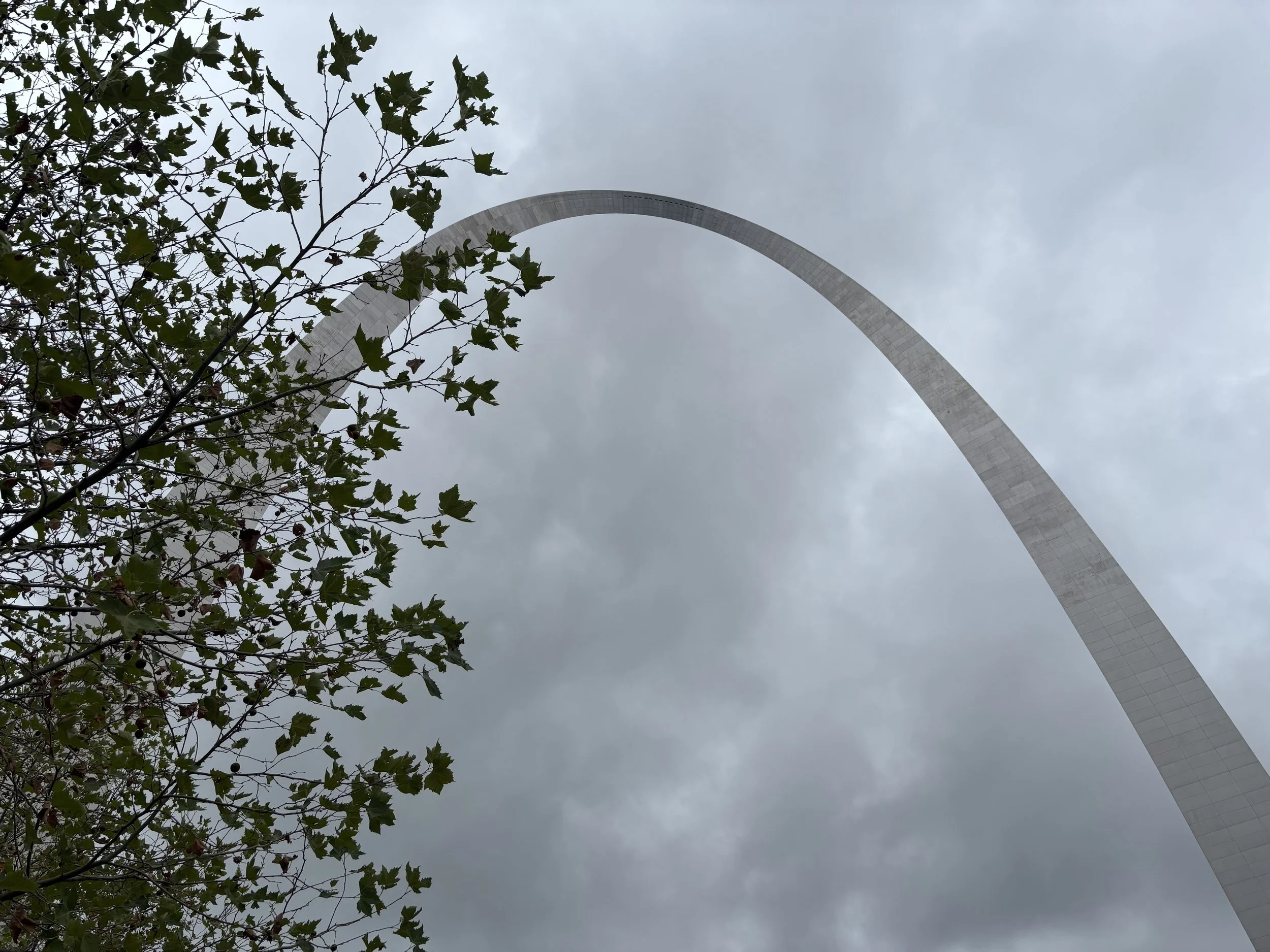
The Gateway Arch in St. Louis // © John Bills
And again, I’m no sociologist, but the drive from the airport to downtown St. Louis was grim enough to dispel any doubts I had about the statistics. The Gateway City was the 22nd city I had visited in North America, but this felt like the first time the curtain had been pulled back. The rain was lashing down from a slate sky and the scene out of the car window was desperate, street after street of boarded-up houses, as human-shaped forms shuffled along in tattered clothes, pushing all of their shit around in shopping carts. Bodies slumped in doorways. Why do people have to live outside? Why? At one point, we passed a man wearing nothing but his underwear and a tattered vest, just standing, staring into the distance, as the rain hurtled down around him like an avalanche of peregrine falcons in spring.
We drove through suburb after suburb, each as miserable as the last, a conveyor belt of post-apocalyptic misery that I knew existed, but had never seen. Now, I am obviously exaggerating this somewhat, but you must remember that this was probably my first adult experience of seeing desperate poverty. I’m sure you could visit, I don’t know, Dhaka, and see something truly wretched. But for me, this damn drive from St. Louis airport to downtown was an eye-opener. We went through Jennings, although I think it is probably more accurate to say that we went by Jennings. Brian (the Uber driver) was quick to remind me that there was a more than decent chance we’d get carjacked if we stopped at the lights in any of these neighbourhoods. I know St. Louis had a reputation, but holy moly. It was like some sort of kenopsia where life continues. Every ounce of colour and life had been drained from these places, and holy shit, John, stop it. The rain was somehow getting heavier as we pulled into the hotel, so I tapped out and put off all sightseeing for the next day. I thanked Brian (thanks, Brian), and holed up in the room for the night.
Fast forward to the next afternoon, and I was sitting in a car with the third best chess player in Nigeria. The Gateway Arch and the St. Louis Blues arena (the Enterprise Centre, if you’re keeping a list) had been explored, and it was time to learn about rooks, bishops, kings, queens, and those smart-ass pawns.
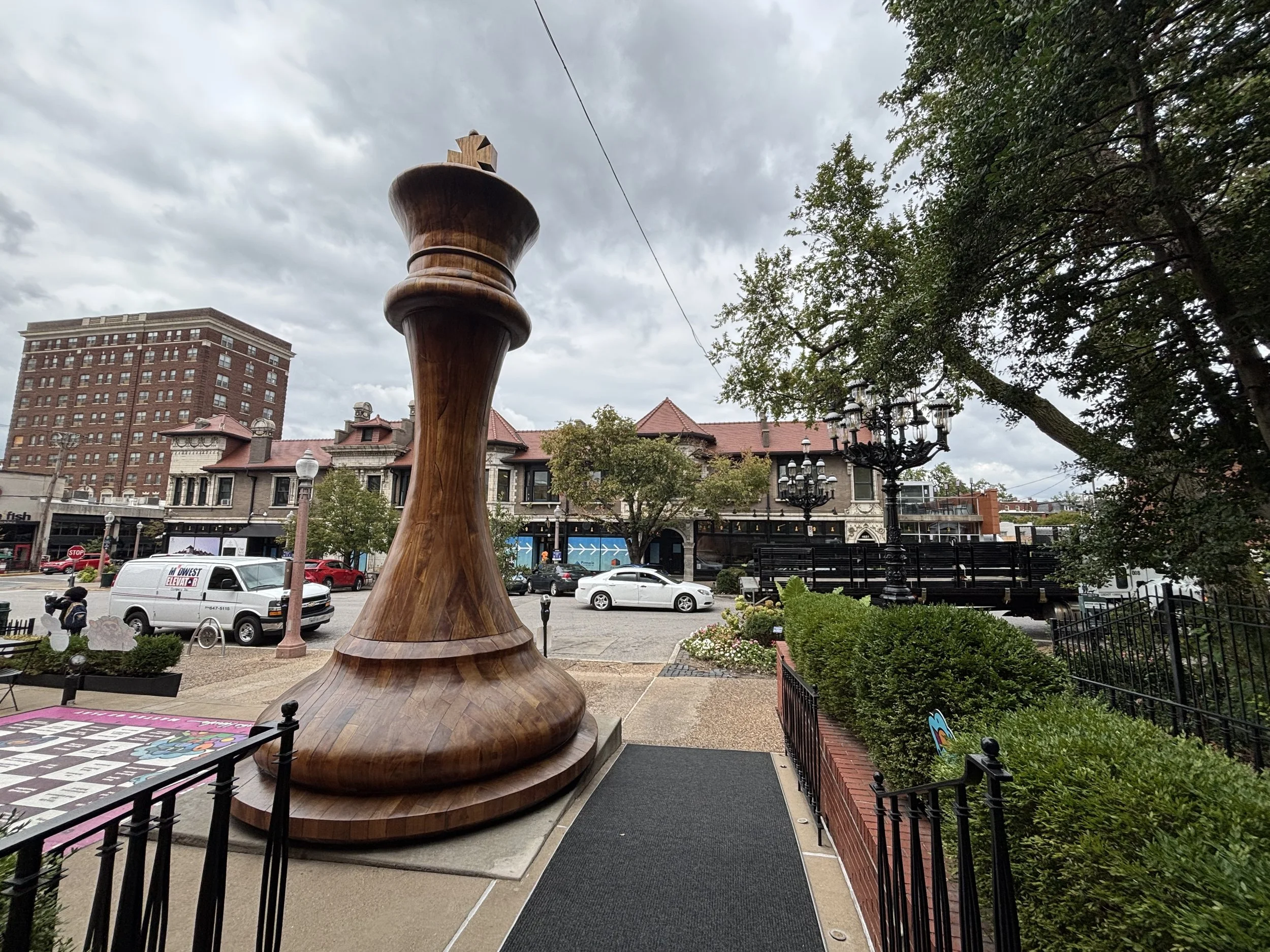
The largest chess piece in the world // © John Bills
St. Louis has rather grand ambitions when it comes to chess, and the World Chess Hall of Fame is (currently) the shining light of it all. It opened in 2011, finding a hopefully permanent home after stints in New York, DC, and Miami. Why St. Louis? Difficult to say, although the city did host part of the first official World Chess Championship way back in 1886, with Prague-born Wilhelm Steinitz defeating Johannes Zukertort 10-5 to take the crown. And yes, both of those men look exactly as you imagine late-19th-century chess wizards to look (stern expressions and thick beards, for the record). Still, it is somewhat tenuous to draw a line from the patience of Steinitz and the impulsiveness of Zukertort to the love of chess in 21st-century St. Louis. The museum I stood outside is largely down to local philanthropists Rex and Jeanne Sinquefield, a couple who established the Saint Louis Chess Club in 2008 and poured money into promoting the game, attracting major competitions, and bringing the Hall of Fame here. The work paid off, and St. Louis was officially recognised as the Chess Capital of America. In 2025, it welcomed me.
And it took all of two minutes inside before I was asked the question posed of every single person who ever comes near a chessboard; “Do you play?” I had no idea how to answer. I mean, yes, I do play, but I didn’t want to play at that moment, and was utterly convinced that answering in the affirmative would inevitably lead to the offer of a game. I just wanted to look at the museum for a while, rather than locking myself into an interminable battle of patience with a chess nut. However, I didn’t want to lie, so I gave the most honest response I could muster, telling the woman that yes, I played, but I was shit. Those were my exact words. “Yes, I play, but I’m shit.” Doused that fire, Bills, good work.
I don’t remember how long I spent in the World Chess Hall of Fame, but it was time well spent. More of an exhibition of chess sets than a traditional hall of fame, it told the story of chess while showcasing boards of all shapes, sizes, and styles, from old-fashioned boards to quirky modern creations. There was a Moby-Dick set pitting sea beasts against the crew, while a Winnie-the-Pooh set offered an altogether more whimsical game. I say that, but there was a time when I was convinced that the central characters in the Hundred Acre Wood were all based on neurological conditions, a theory I still partly believe, and there’s got to be something in putting that into a game of chess. Would Tigger’s manic energy lend itself to the role of the rook? Eeyore makes sense as the knight from an anatomical perspective, but from a tactical one?
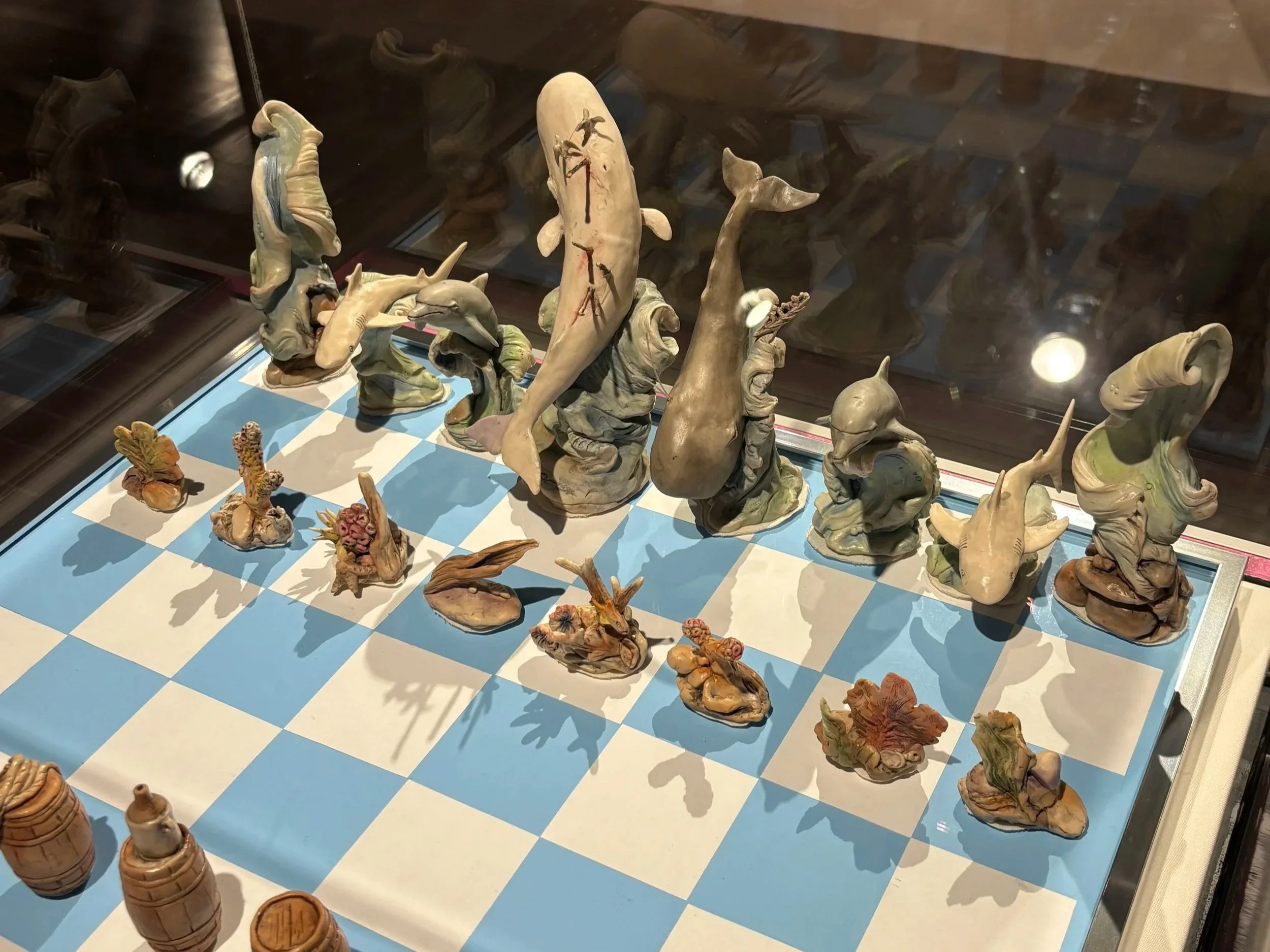
Moby Dick chess set // © John Bills
Chess is a fascinating game. When I started learning how to play, it was difficult to embrace the utter boredom of it all. Why waste time building when you could go straight for the kill? This was exacerbated by the fact that I only played against a computer. It didn’t lend itself to the slow-burn of the game, because the computer is perfect. In a fraction of a second, it could weigh up every single possible move and make the best one, based on my moves and how I’m playing. From the get-go, it seemed utterly impossible to beat the computer in a traditional sense, and my only feasible option seemed to be chaos. Make a few rash moves, try to claim some key pieces, and remove all logic from the match. The computer thinks it is playing a logical opponent, but the digital figure at the other end of the board was a maelstrom of insanity.
And for a while, I thought this was a good plan. I won some games, I lost some, but I chalked the losses up to my opponent’s perfection and dismissed my successes as the lucky flailings of a drowning man. Homer Simpson hitting all of the rocks on the way down. A broken clock is right twice a day, and all that jazz. (Hed) PE wrote Broke. You got lucky, Bills.
The eagle-eyed (cherry) among you will see where I’m going with this. At some point, I stopped making stupid moves and decided instead to take my time. I still struggled to build positions and plan, but I made a conscious decision to care less about results and more about reducing mistakes. Instead of just spraying my main pieces across the board, I tried to control the centre, accepted that castling happens, and slowly started to see my game improve. Not by leaps and bounds, but little by little. Don’t try and win spectacularly. Just try not to lose too stupidly.
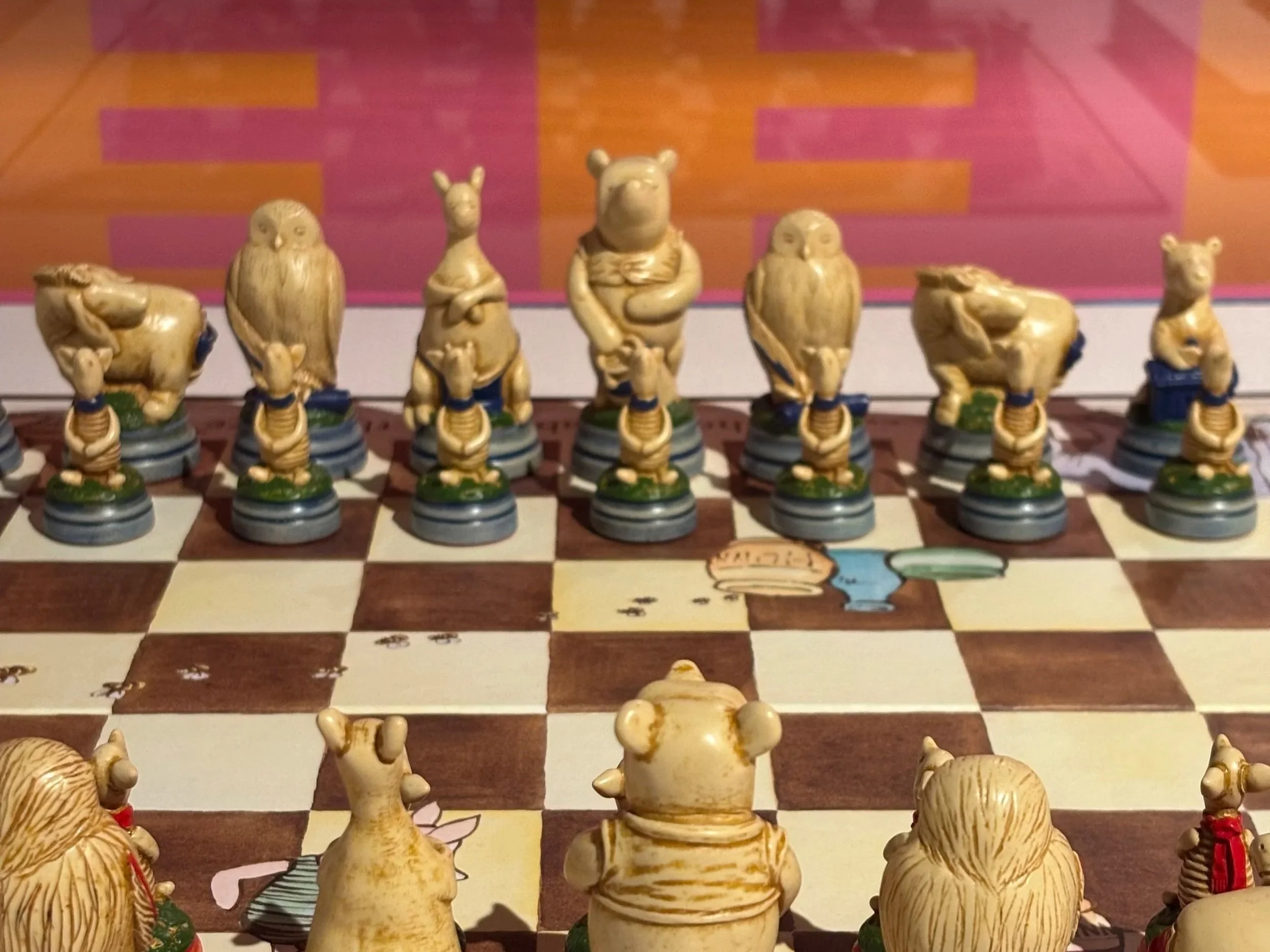
Winnie the Pooh chess set // © John Bills
I also realised that the computer wasn't quite as perfect as I'd imagined. I mean, it was perfect at playing to whatever level it had been assigned, but that was the point: I eventually clicked that every game I played against that moustachioed fool on Duolingo was set to a predetermined difficulty. Sometimes the computer was unbeatable. Other times, it was a total beginner. Either way, I had no idea until things started unfolding. For some reason, that helped.
So yeah, go with the lazy analogy. Take your time, try to reduce your mistakes, and don’t stress about outcomes. Nobody else is perfect, so stop trying to be. Tigger is a rook. Eeyore is a knight.
And where does St. Louis fit into all of this? In truth, it doesn’t. It just so happens to be where I was. Somewhere deep within this article, there is a deep dive that draws a line between the appreciation of a city and a chessboard, about how you can only appreciate it by taking the whole thing in, about how there are mini-worlds across the board but it all comes together as a perfect whole, that sort of thing. That’s the article I should have written, but you’re just going to have to dig deep and find it for yourself. Take your time.

A sunrise in St. Louis // © John Bills
St. Louis was a strange place, but the morning light was spectacular. The sun started peeking above the horizon around 6 in the morning, and I was able to sneak out to the corridor and the full-length window to get a look at the mighty star rising over the Gateway Arch. A couple of hours later, it felt like it was still rising. St. Louis left a lot to be desired, but the morning light was unlike anything I had ever seen or experienced. It didn’t magically make the place beautiful, but the Gateway City could not be accused of skimping on the framing. Still, it was time to leave. The Uber driver was a guy called Dorian, a St. Louis native, and undoubtedly one of the most engaging Uber folk I’d experienced on either North American trip. The conversation flowed easily. There were no outlandish claims of lost opportunities. Just two dudes talking about stuff. Dorian, you will never see this, but thanks.
St. Louis airport was utterly uneventful, and I soon boarded a flight to Minneapolis-Saint Paul International Airport, where I would meet Eric and continue this journey through the many cities of the National Hockey League. A nervous mother approached my row, sat her daughter down (I’d guess 7 years old), and told me she was with a younger child a few rows up. She apologised that I would have to sit next to a child, which seemed somewhat unnecessary but not a problem at all. The girl didn’t seem to mind. She whipped her phone out of her pocket and was almost immediately lost in whatever it was that the little piece of miracle technology had to offer.
And yes, dear reader, this bow might seem a little too perfect, but I assure you, it was true. She was playing chess.