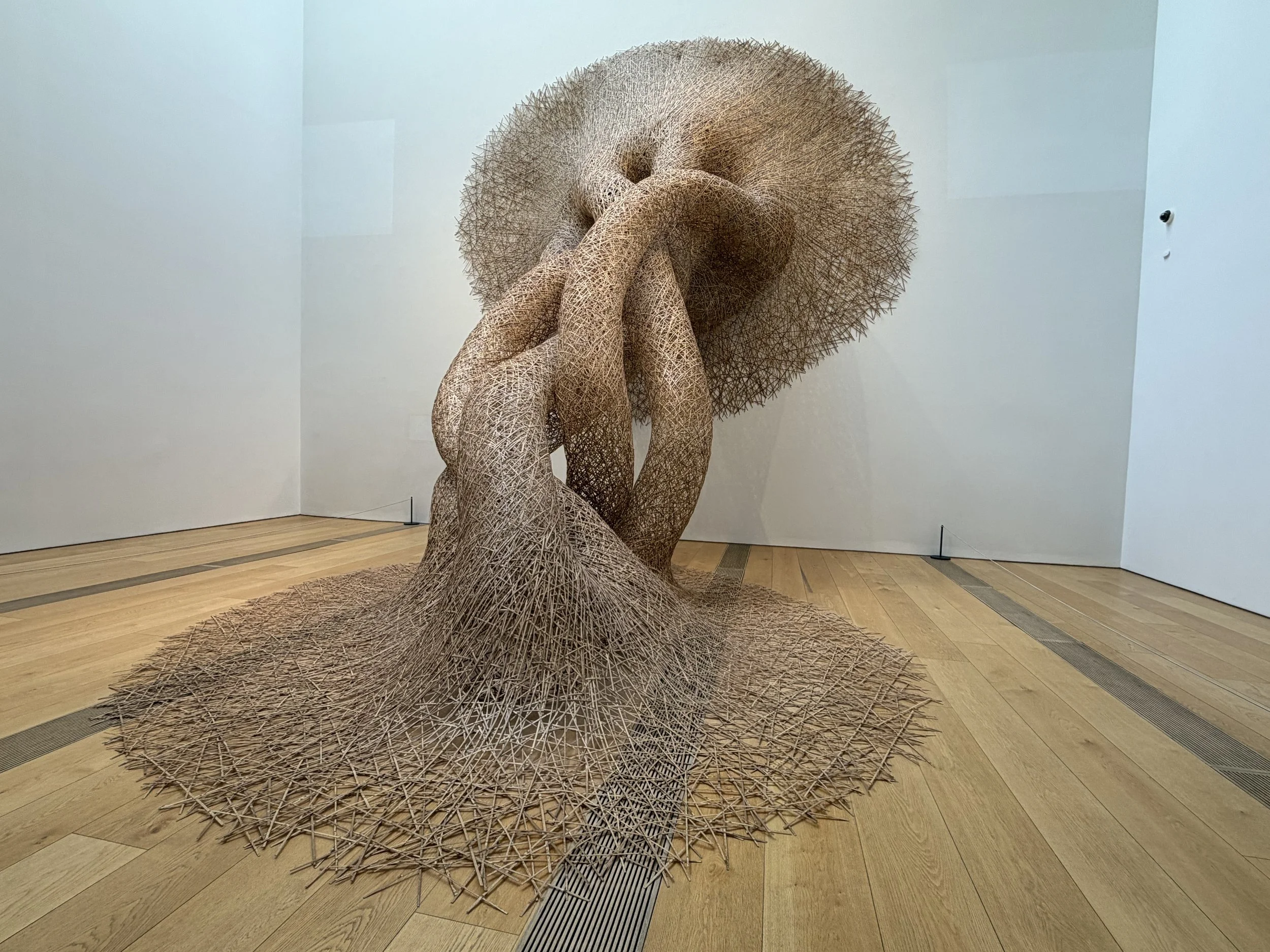
A bamboo sculpture in Eskisehir // © John Bills
As I sit at the kitchen table in my darling apartment in Sarajevo, almost nine months have passed since my first trip to Turkey. If I contracted pregnancy (yes, that is the right term) the night before flying from Tuzla to Istanbul, I would now be lumbering around the apartment with a real combo, unable to put my socks on or tie my shoelaces, two things I am going to pretend I am currently able to do without any noticeable issue. Of course, I was not pregnant, but this does a good job of eating up 100 words or so.
Turkey was one human gestation period ago, but I am still no closer to any understanding about meerschaum.
Nine months prior, I wasn’t all that close to understanding Eskişehir. Turkey (or Türkiye, if we’re ticking boxes) was still new to me, and as I wandered around the seemingly deserted streets of Eskişehir’s old Odunpazarı district, I was struggling to remember why I had it on the itinerary. Was it the convenience of a relatively quick train from Istanbul? That makes sense, but there were other options on the line. Was it the lure of a city known for canals and a vibrant student culture? Possibly, although more the former than the latter. I am 40 years old. Once the sun goes down, my day is done. Maybe it was the meerschaum? I guess it was the meerschaum? Eskişehir is known as the capital of meerschaum, after all. Still, I didn’t know what meerschaum was. I still don’t.
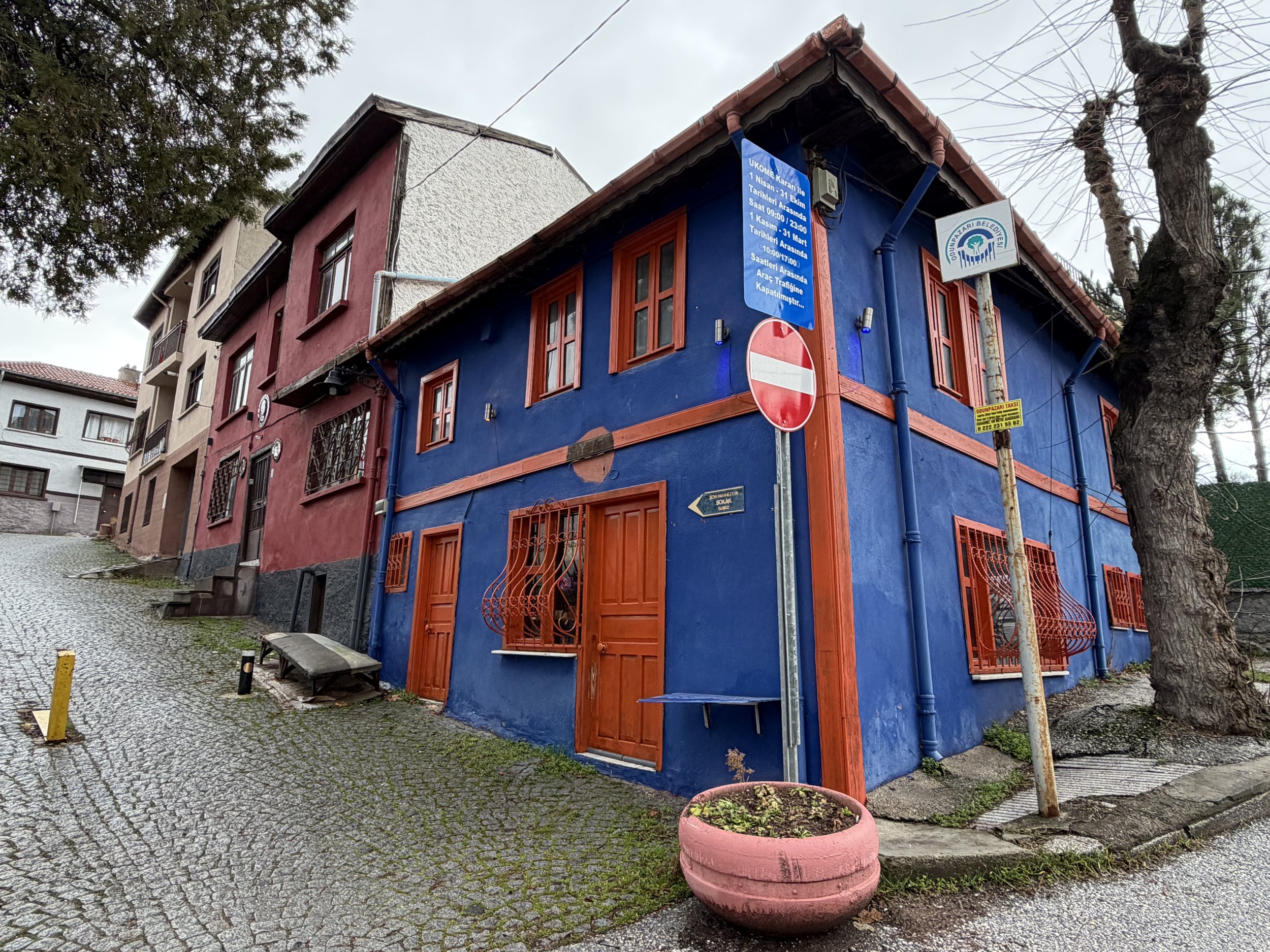
Colourful buildings in Odunpazari, Eskisehir // © John Bills
I had to get there first. After another disappointing breakfast at the hotel in Istanbul, I tidied up Horse and prepared to depart. I checked out of the hotel and wandered down to Sirkeci station before boarding the metro train to Söğütlüçeşme. Look at all those diacritics. No, I don’t know how to pronounce it, no matter how often I hear it. The train ride to Eskişehir was uneventful, with the exception of a free sandwich that was among the worst sandwiches I have ever had the misfortune to taste. Good lord. I think it was cheese and tomato, but I know it was sadness in sandwich form.
The landscape from Istanbul to Eskişehir looked the same as that seen when travelling by bus through Bosnia. Is everywhere the same? I know that isn’t true, but how much of it comes down to perception? I saw plenty of Spain by train (hah) in February 2025, and I don’t remember it looking a whole lot different to this. Considerably less green, that’s for sure, but not a million miles different. I can convince myself that Herzegovina and Bosnia look completely different, but why the struggle with differentiating between Turkey and Andalusia? Bias, I guess. Bias, attention, perception. Are bias and perception too similar? I don’t know, but that all sounds like something a musician would say in an interview before being celebrated for being some sort of philosophical genius. It’s just words, man. I think this new album is our best work yet. The heavy bits are heavier, the melodic bits are more melodic.
Less than an hour after stepping off the train in Eskişehir, I was stepping out of the hotel and into the town. It was already late, so there wasn’t much exploring to be done on that first night, but I wanted to do at least one LRT to get my bearings. This was an LRT in the truest sense; I walked 30 minutes from the hotel, did a mini LRT around the market stalls, stopped for a coffee, and then walked 30 minutes back to the hotel. I saw people streaming in and out of the Reşadiye Mosque, I saw some joyfully stereotypical haggling over spices, and I saw a lot of groups of dudes drinking tea and staring into the distance. Eskişehir definitely seemed like a place.
But what can anyone fully understand from a simple lap round town? I took a few moments to admire the Reşadiye Mosque, but didn’t learn anything of its history. I didn’t learn that it was constructed at the beginning of the 20th century, commissioned by Ottoman Sultan Mehmed Five, a dignitary who essentially spent 33 years under close supervision before becoming sultan at the age of 64, a devoted Mevlevi Sufi who had the misfortune of taking the throne as the empire around him was taking its last breaths. Sure, he was a figurehead and little else, but history remembers figureheads.
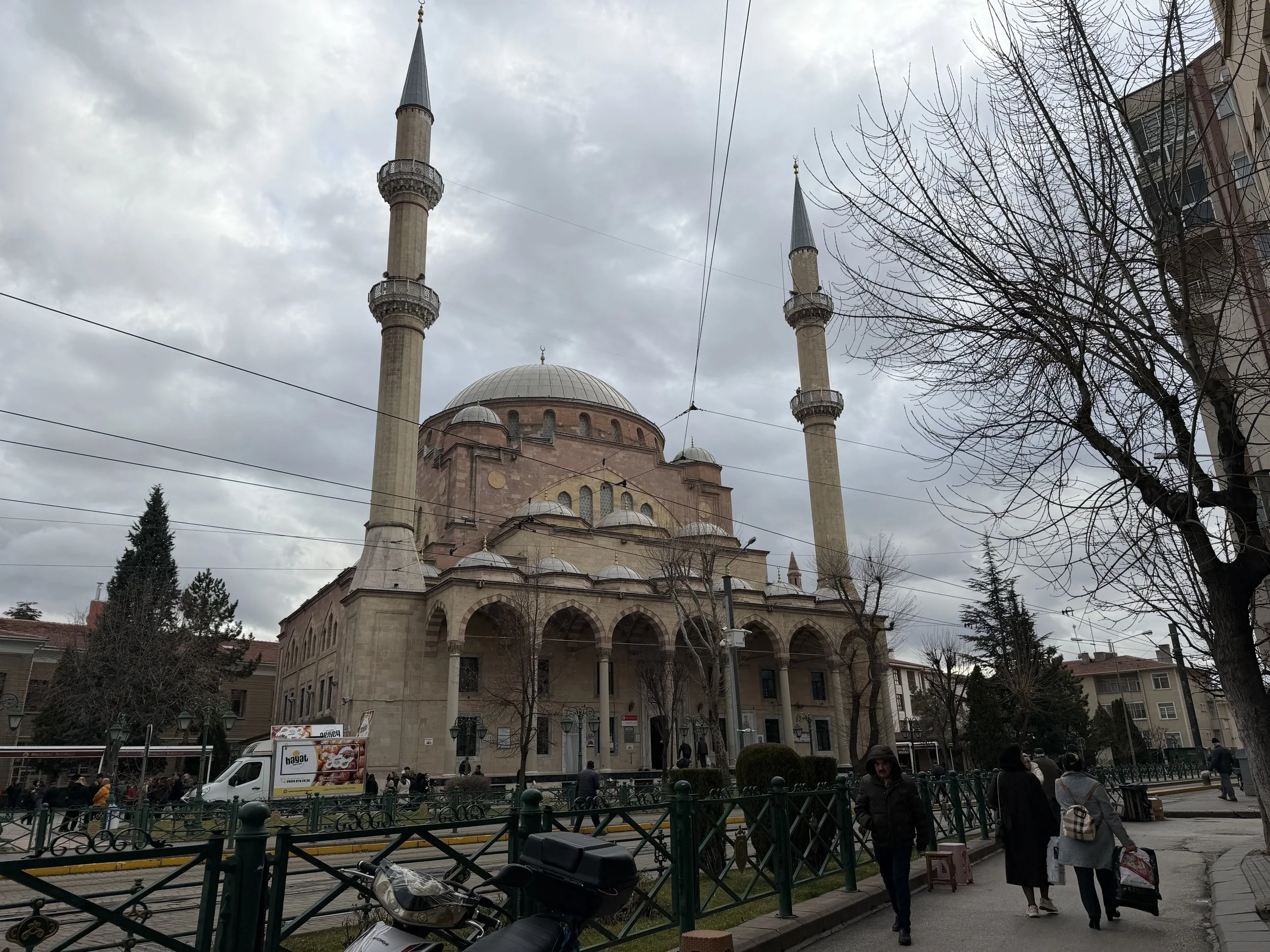
Resadiye Mosque in Eskisehir // © John Bills
And I didn’t learn anything about him from spending a few minutes looking at the mosque. I didn’t learn that the original building was a modest structure with a wooden roof and a single minaret that was eventually replaced by the present mosque between 1969 and 1978. I didn’t learn that the architect, heavily influenced by the New Mosque in Istanbul, died before it was completed. My need for bearings trumped the importance of detail.
Despite the heavy clouds and incessant threat of drizzle, I had higher hopes for day two. The worrying weather was an empty gesture, and by the time I passed the Reşadiye Mosque on my way to Odunpazarı, the sun was dragging itself into a begrudgingly clear sky. I was pleased, chuffed, and allowed myself a mild feeling of optimism that my plans would be realised. I was in Odunpazarı, the historic heart of Eskişehir, named after a wood market but now known for its Ottoman-era houses, their projecting upper floors, and polychromatic facades. In many ways, it is a classic Ottoman old town, almost theatrical in its nostalgia, but deserving of all the glowing words the internet throws its way.
My first port of call was the Tayfun Talipoğlu Typewriter Museum, named for the popular Turkish journalist who built a career travelling around Turkey giving light to the stories of ordinary people. Talipoğlu donated much of what is found in the typewriter museum, a quirky love letter to the 19th-century invention patented by Sholes, Glidden, and Soule. They might look clunky and somewhat obsolete in a world of pocket word processors, but the typewriter transformed the written word, allowing the production of legible documents to happen considerably faster. That QWERTY keyboard you’re so familiar with? Chalk that down to the typewriter. Next time you’re smashing out 1,700 words about Eskişehir on your laptop in the kitchen, pay thanks to the typewriter.
Alas, I didn’t learn any of this in Eskişehir, because the Tayfun Talipoğlu Typewriter Museum was closed. It had been closed for years, another victim of the COVID-19 pandemic. The opening hours remained on the door, but the door was locked, no matter how many times I pushed. Sometimes, a closed door is a closed door. The rain had returned.
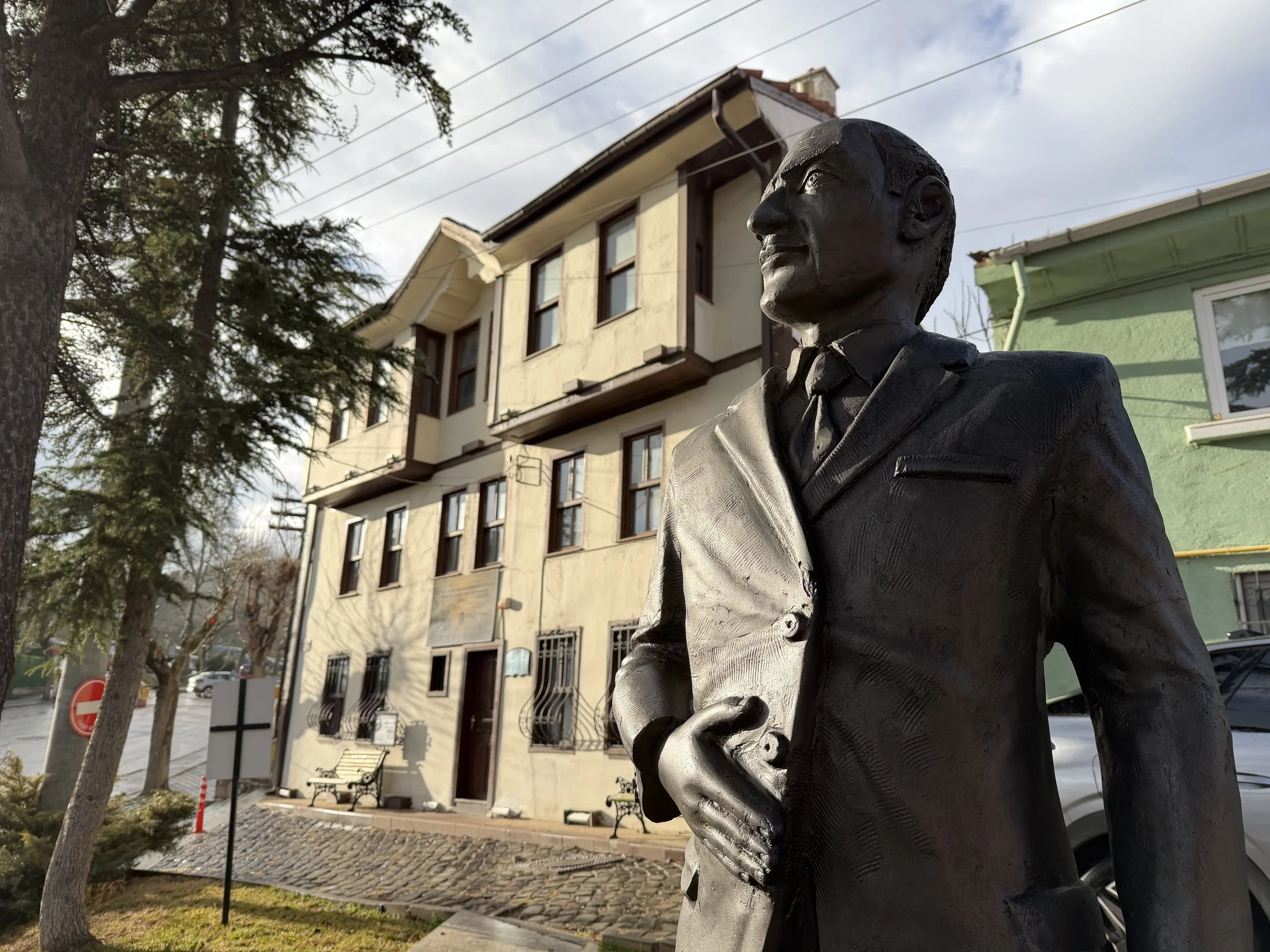
A statue outside the typewriter museum in Eskisehir // © John Bills
It was only a pitter-patter (not to be confused with a pili-pala, the Welsh word for “butterfly”), so I meandered around the old streets of Odunpazarı before heading across to the Kurşunlu Mosque and Complex. Now, I don’t need to tell you that the mosque was locked, but it was, so I’m telling you, and my dwindling options left me with a gift shop and the Meerschaum Museum.
And if you’ll refer back to the opening paragraph of this piece, I am still none the wiser about meerschaum. I know that the museum is housed in the mosque complex, and that it celebrates the city’s most distinctive natural resource. The museum amounted to little more than a few information boards and many shops where visitors could buy anything from meerschaum jewellery to meerschaum sculptures, but the real stars were the meerschaum tobacco pipes. I bought one, supposedly an owl, though I’m not entirely sure about that. My eyesight is notoriously poor, but I know an owl when I see one.
But I didn’t learn anything about meerschaum. There were around 3,234 members of staff, but I don’t speak Turkish, and they didn’t speak English. I am to blame there, being in Turkey and all that, but an admission of guilt wasn’t going to lead me to the plains of Shinar. Ultimately, I bought the tobacco pipe out of guilt, out of a sense that it was significant yet beyond my understanding. I don’t know what meerschaum is, and any real attempt to detail that here would be disingenuous. Besides, I needed the toilet.
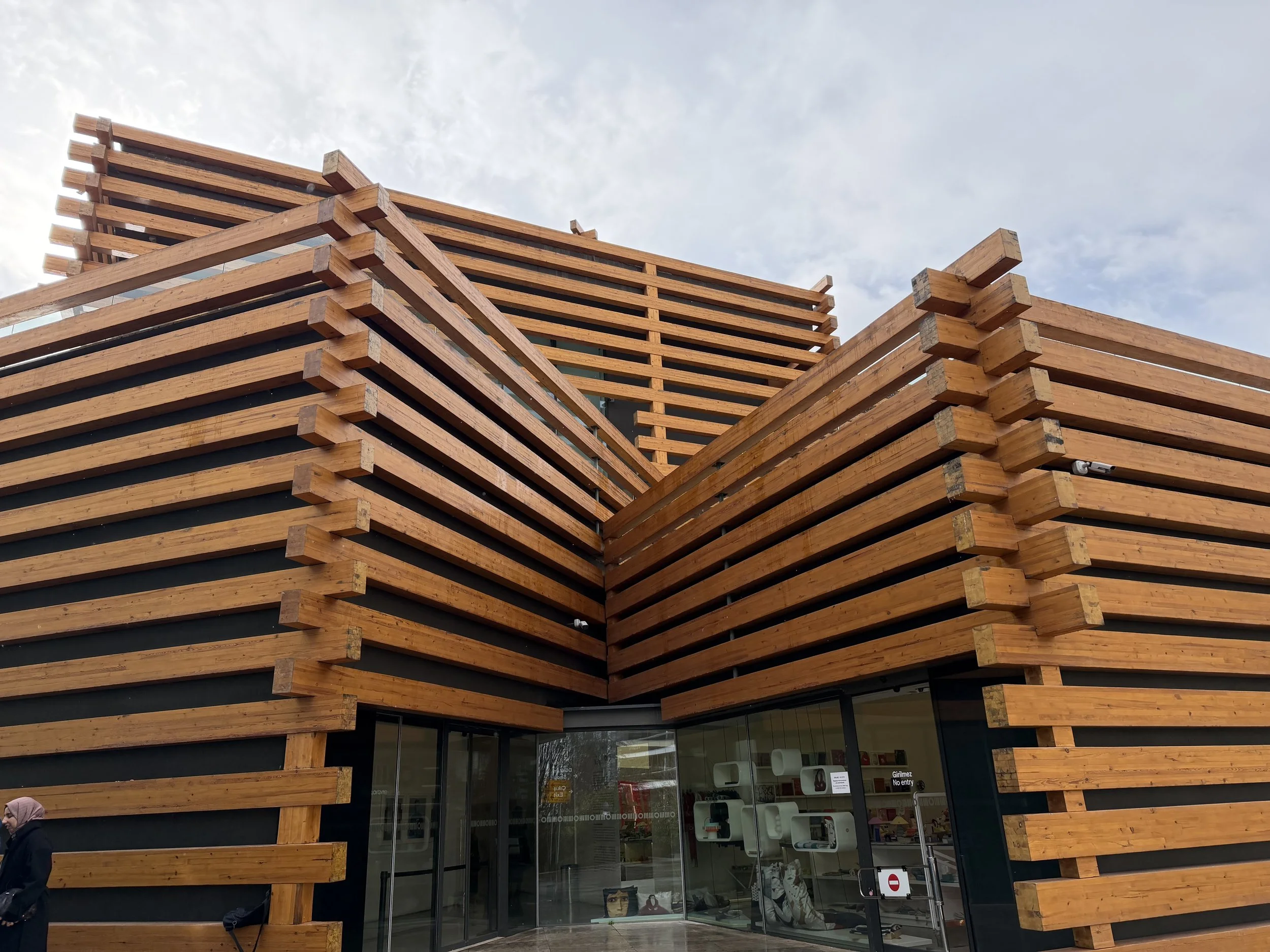
Odunpazari Modern Museum // © John Bills
The Odunpazarı Modern Museum was open, and its striking Japanese-inspired timber construction stood out like the most beautiful sore thumb in this traditional old district, its stacked volumes making a case for the most arresting structure in the city. The art inside was spectacular, a treasure trove of innovative work from Turkey and around the world, ranging from playful portraits to stacks of televisions playing old Turkish wedding videos. There was photography, textiles, sculpture, a stunning bamboo piece by Tanabe Chikuunsai IV, and a particularly delightful video of an opulent table set for a feast in the Arizona desert. It all went way over my head, as art is wont to do, but the pretty colours and thoughtful shapes distracted me from the sense of detachment I have perfected over the last 20 years. If that isn’t the purpose of art, then I don’t know what is.
I mean that literally; I don’t know the purpose of art, but I’m not going to understand its depth from a slow walk around a museum in Turkey’s 11th-most-populous city.
I stopped briefly at the Independence Museum, located in the impressive Mestanoğlu Halil Mansion, where commander İsmet İnönü (me neither) stayed during the Battles of İnönü. For some reason, I struggle with Turkish museums of independence. Did they not rule the Ottoman Empire for centuries? Who were they gaining independence from? Themselves?
The blame for that lack of understanding lands on my weary shoulders, but it wasn’t about to be exhumed from four rooms in a single museum.
Keenly aware of my inability to grasp information, I made the Museum of Trade and Industry my final stop in Odunpazarı, still optimistic in the hope that a vague atmosphere of progress would be infectious. The setting was familiar, another Ottoman-era mansion, and the collections in the museum impressed without too much need for engagement. There were representations of King Midas, information about the Devrim, Turkey’s pioneering domestically produced automobile, newspaper clippings, musical instruments, and a lot more. To a less foggy brain, it would have been something special, but the cumulus man is no place for wisdom.
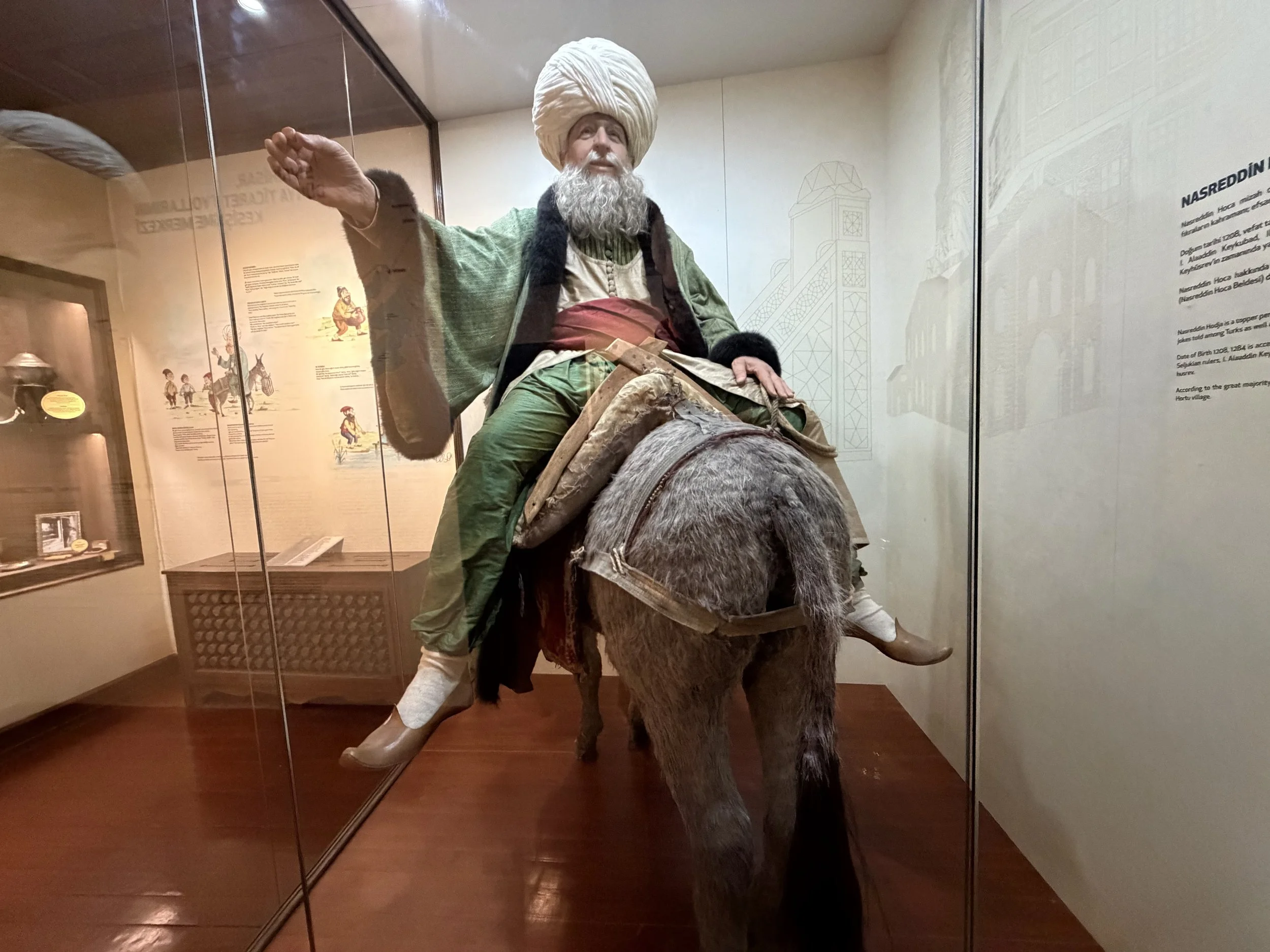
Nasreddin Hoca on his donkey // © John Bills
Inevitably, I was drawn to Nasreddin Hoca. My love for donkeys is well documented, so the stories of a man riding backwards on such a magnificent beast were always going to strike a chord, but there was something else here. Said to have been born in what is now Eskişehir Province, Nasreddin is a peculiar figure in Turkish history, a folk philosopher with a penchant for the absurd. He rode his donkey backwards because travelling normally would have meant turning his back on his students or them turning their back on him. His solution was whimsical yet logical. I said a silent prayer, desperate to one day discover my own source of Nasreddin Hoca-esque clarity.
I stopped in a shop before heading back to the modern city, and spent a few moments deciding on a magnet. Nasreddin Hoca dominated, but his likeness was so distorted on each souvenir that I wasn’t sure if it was parody or simple adoration. I bought one, arguably the least convincing magnet I had ever purchased, but conviction is half the battle.
Meerschaum is a soft, white mineral, also known as sepiolite.