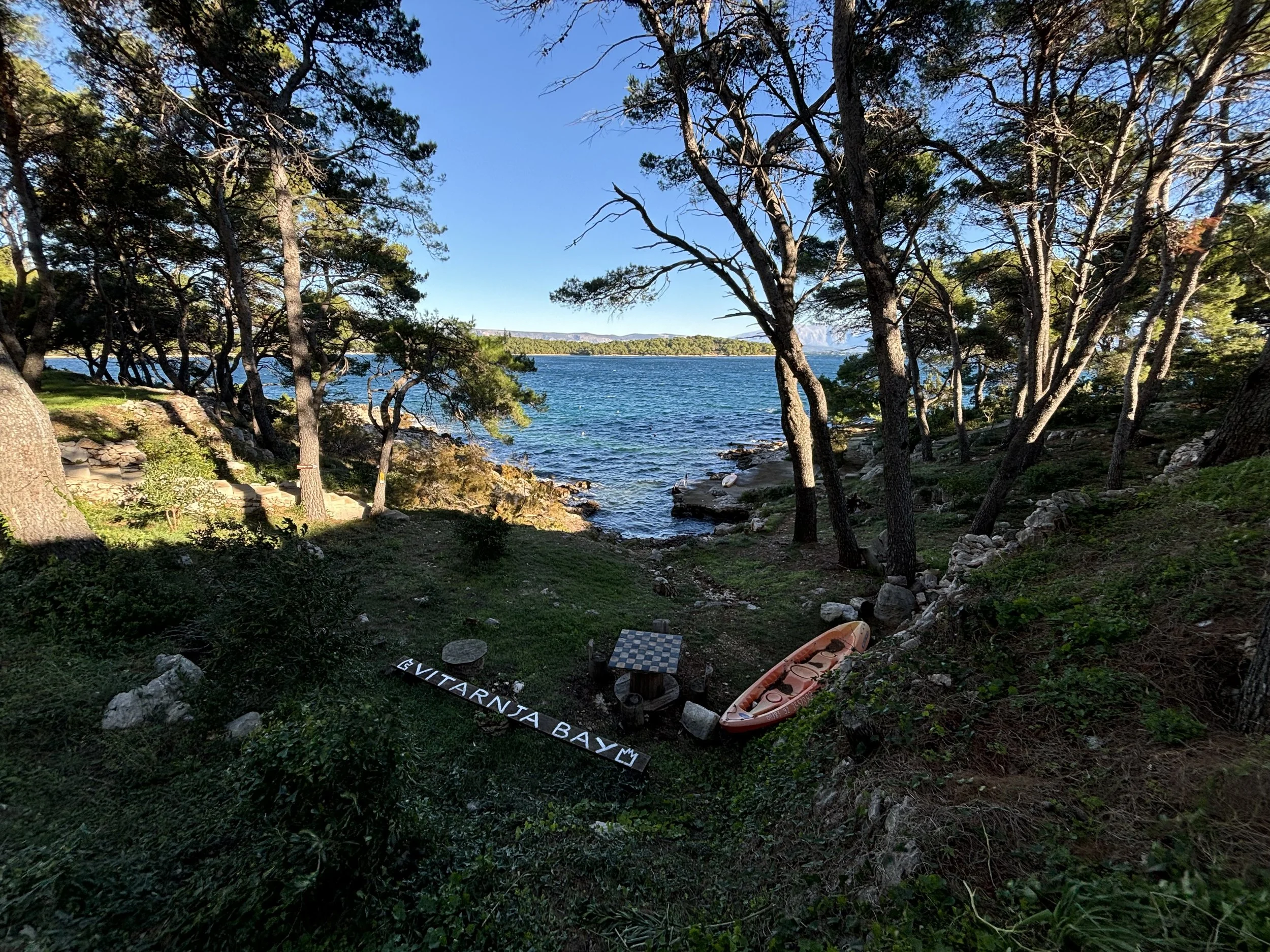
A view on the walk to Vrboska // © John Bills
Best-laid plans and all that shit. We have been here before; a conviction that I can walk a long way and learn a lot in the process, usually through some form of former Yugoslav landscape, a conviction born from very little evidence and even less experience. Usually, Bosnia and Herzegovina hosts this fantasy, but that fever dream isn’t confined to the Heart-Shaped Land. In this instance, the Dalmatian island of Hvar served as host. Furthermore, I actually put in three solid days of walking, each as successful as the last, although blisters appeared almost immediately after each concluded, suggesting that my feet aren’t quite up to the task. The moral of the story is nothing, but we won’t get fooled again.
The first walk began in Jelsa, about as quintessential a town as you’ll find on Hvar, tucked into a sheltered harbour on the north coast, a honeycomb maze of stone buildings and shuttered windows. It was November, so the only movement on the waterfront was fuelled by the bura (a brutal wind, if you’re new here), dragging moored boats shoulder to shoulder but no further, all nervous lovers, wandering around empty streets on their way to the cathedral. My blister litters the galaxy, and that line about Foxy Loxy and Ducky Lucky’s throat is probably a little too much, but just know I considered it.
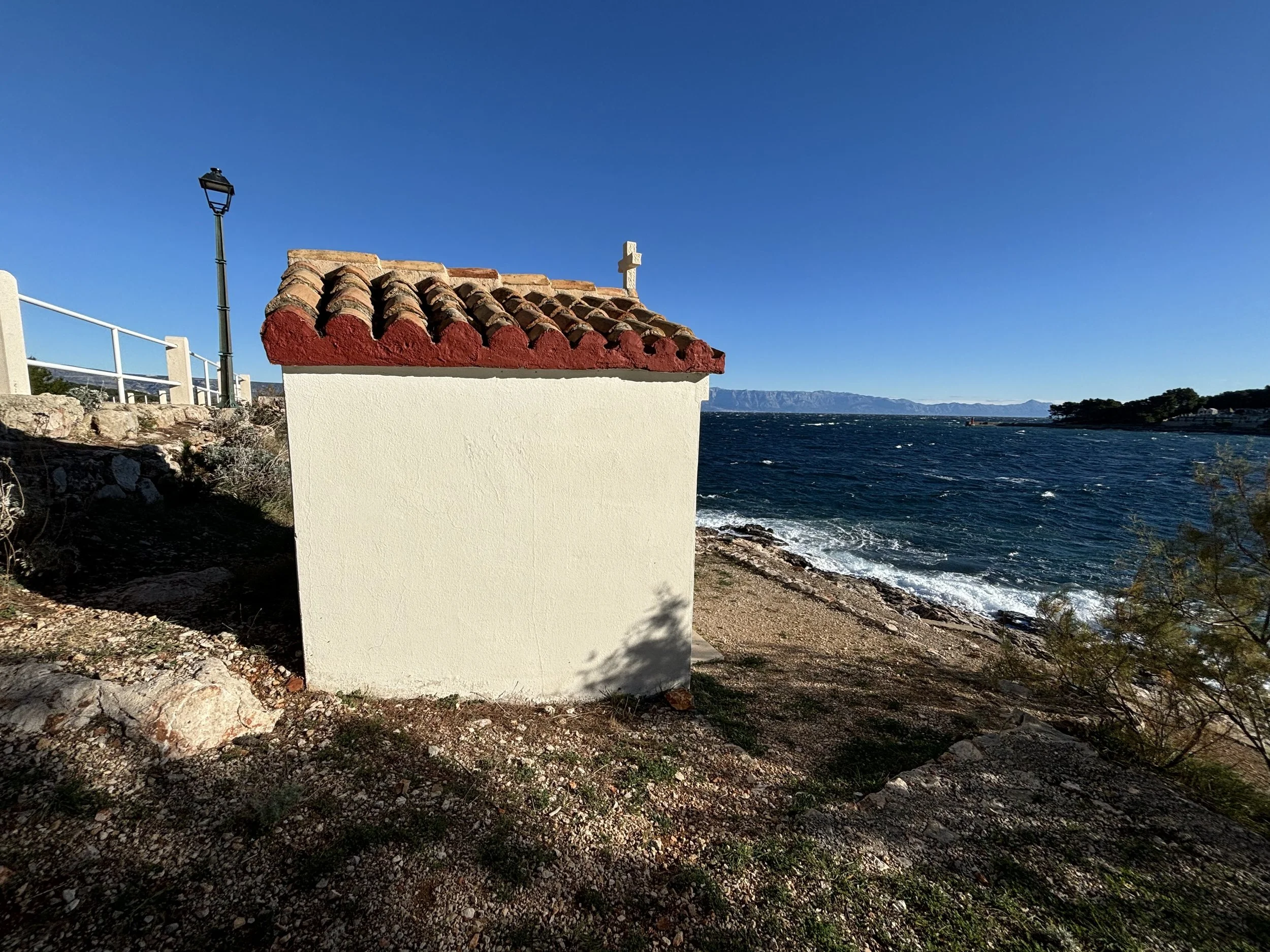
A view on the walk from Jelsa to Vrboska // © John Bills
But yes, Jelsa, first mentioned in the 14th century, blossomed in the 19th, ticks its tourism boxes today. I was on the island to do some research for a guidebook, and decided to base myself in Jelsa. The island was quiet, it being November and all, so Jelsa got the nod. A central position certainly helped, as the inconsistent public transport at this time of year meant I would have to rely on taxis to get around the island.
Or walk, obviously.
The first walk was a relatively simple one that followed the sea for 4 kilometres to the neighbouring village of Vrboska. Now, that sounds manageable enough, but that bura isn’t messing around. The walk is all rocky coves, pine trees, tiny beaches, and faded graffiti, none of which proved distracting enough to justify hanging around in the wind. The water provided more than enough charm, shifting from deep blues to pulsing turquoise and back again, running a gauntlet of blues that should stop a man in his tracks. Alas, November, wind, kilometres. One foot in front of the other. Eventually, Vrboska appears around the inlet, offering much the same in the way of stone houses, narrow harbours, and moored boats flirting with each other. Some call Vrboska “Little Venice,” a nickname that does neither side much good. Venice is a world unto itself, and casting Vrboska in its shadow only diminishes the delights of its stone bridges and nearby pine forests. What would it have been like in the 15th century, when Vrboska as a defined settlement began? Or even further back, when the Romans were hanging around? A damn sight noisier than this November morning, I imagine. There wasn’t a soul to be found, with the exception of the ubiquitous chainsmoker staring out at the water. I’m never entirely sure if he is real, but he is always there.
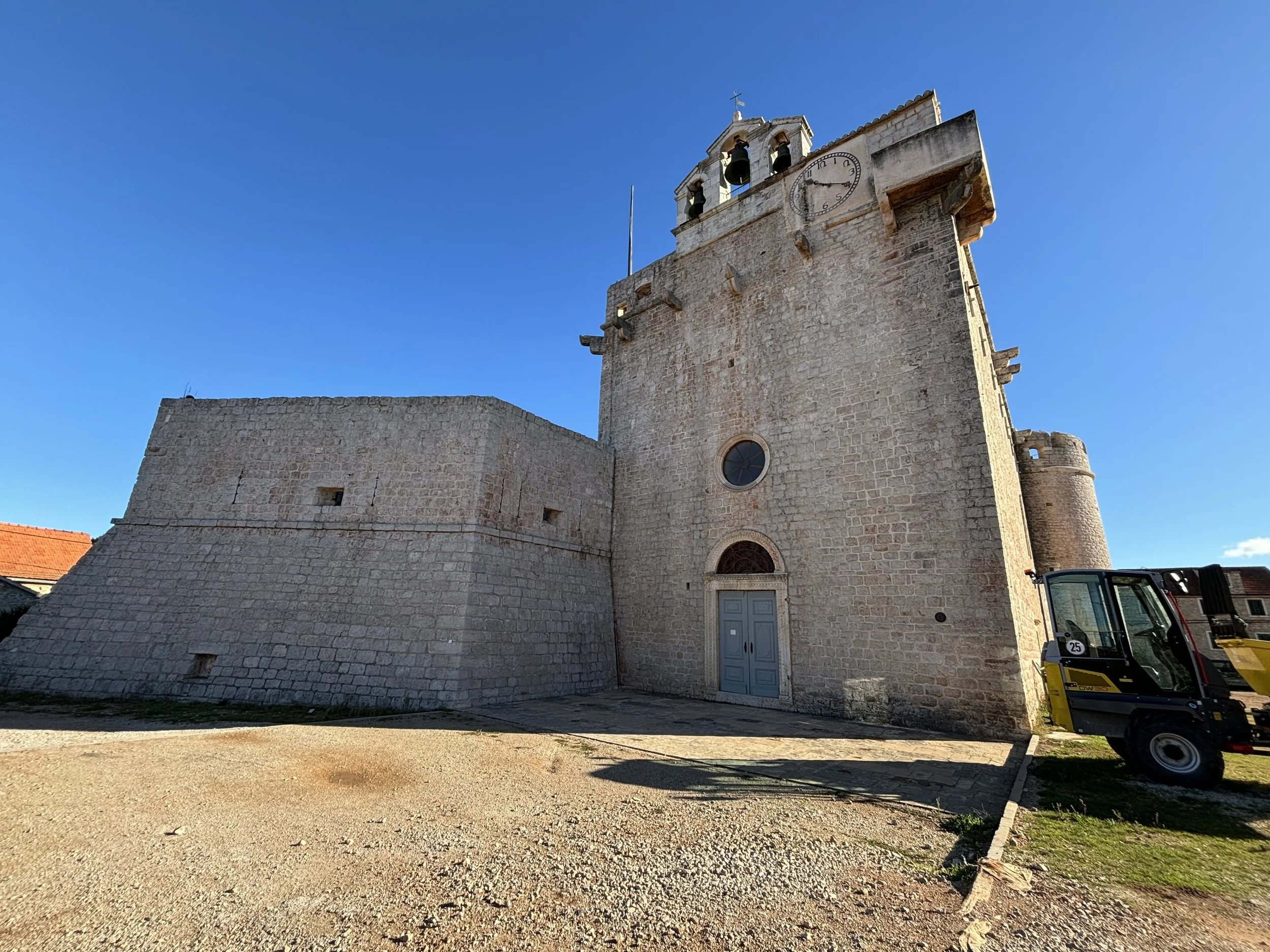
The fortified church in Vrboska // © John Bills
Instead of stopping to yap with the guy, I briefly loitered around the fortified Church of St Mary of Mercy, a house of worship that met its judgement day when attacked by the Ottomans in 1571, only to be rebuilt with defensive features. Religion and the military, hand in hand, side by side. No nervous flirting here. No people either, and no open doors, so I enjoyed another LRT in Vrboska before beginning the next lap of the day’s walking: a 6-kilometre stretch to Stari Grad.
And we’ll power walk through this section. I started walking, turned back to see a bus heading my way, flagged it down, and jumped on. Is that cheating? No, because there are no rules here.
The bus got me to Stari Grad, arguably the most historically significant town on Hvar, although it wears that age with less fuss than many contemporaries. How old? Greek colonists in 384 B.C., that old, originally called Pharos after the origin of those colonists (Paros, keep up). The Greeks established an agricultural colony, dividing the surrounding plain into plots whose ancient boundaries remain visible today, the fabled Stari Grad Plain, a UNESCO World Heritage Site worthy of the junta’s attention. The town itself hits many of the same notes you expect from a Dalmatian settlement, the stone houses, the narrow lanes, the small squares, the quietly confident churches. It had some of the people, too, despite the calendar, and there was even a gaggle of children playing outside the walls of Petar Hektorović’s summer residence. But that was over; history won’t end. I sat for a coffee, keenly aware that the villages in the hills were unlikely to offer much in the way of caffeinated refreshment, and soon found myself back on the road.
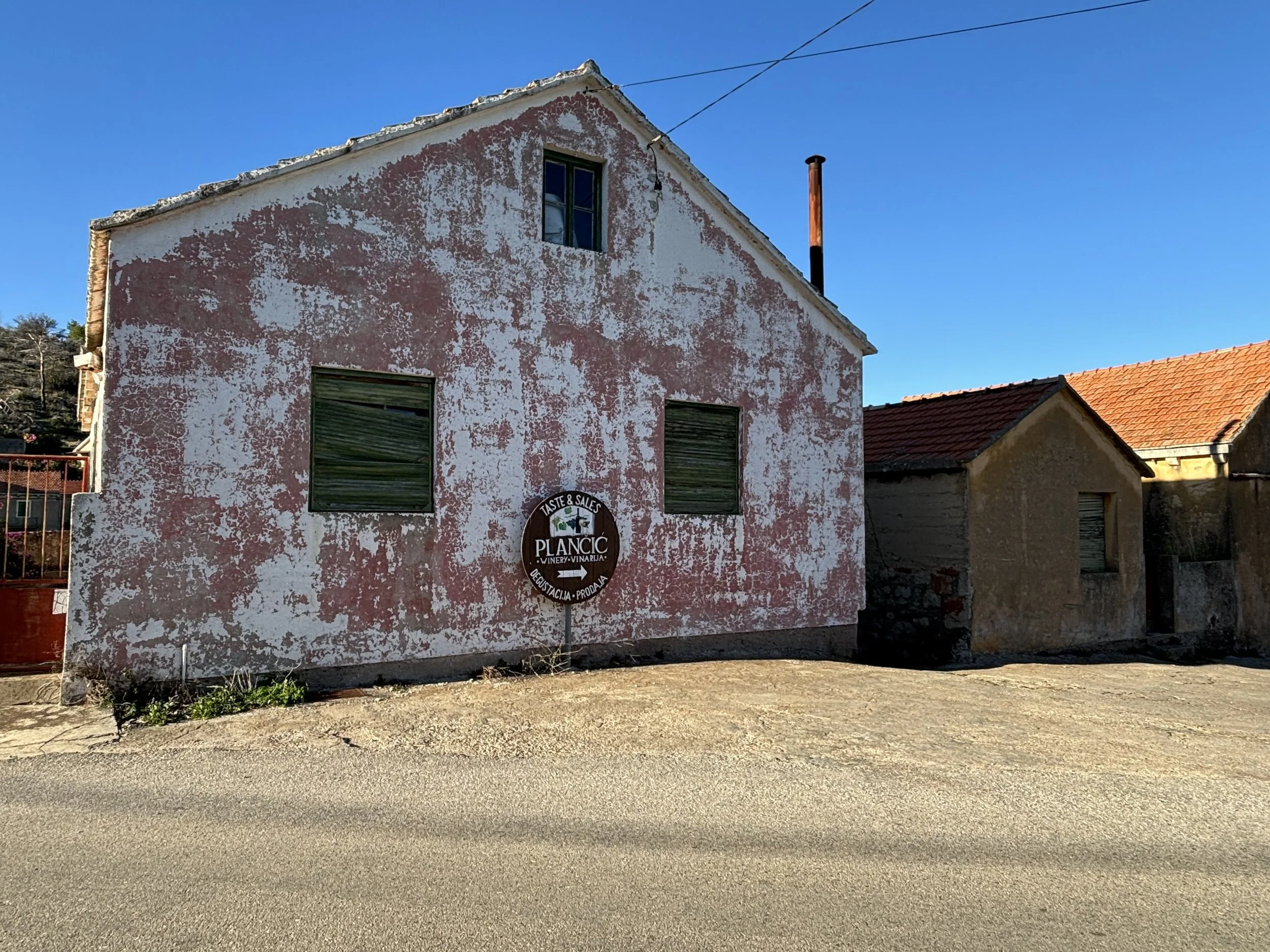
A building on Hvar // © John Bills
Dol was my next stop, a mere 2.5 kilometres away, albeit up the sort of steady gradient that tends to be my kryptonite. However, there was very little of the arduous about this walk. Yes, the gradient, but the road was wide and paved, there was next to no traffic, and there didn’t seem to be any wild dogs either. Or bears, which is always a positive. It took 40 minutes or so, but I arrived in Dol. To the best of my memory, I was out of Dol merely five minutes later. That isn’t meant to be anything disrespectful to Dol, but this is a very small village tucked between two green valleys separated by a hill. I saw some houses, a church, and delightful views back towards Stari Grad. If I were driving, I would have stopped to admire all three, but I do not know how to drive. I was walking, and while this route was theoretically taking me in the direction of Jelsa, it wasn’t getting me any closer. The longer I stood to admire Dol, the sooner the lactic acid would start pooling, so I had to keep moving. Time waits for no man, particularly not for men with newly acquired blisters. I will wait for my blister. I will always wait.
And on I went, further from the sea that draws the crowds and deeper into the land that fuels its people, the agricultural heart of Hvar, through a landscape of cultivated land and silence. For want of a better word, it was charming. You could even throw “verdant” in there, if you’re doing some sort of travel writing bingo, but you won’t get a “traditional yet modern.” The walk from Dol into the hills was all tradition, no modernity, at least until I approached Vrbanj, one of the island’s largest inland villages, with a documented history beginning in 1331 but a memory that stretches back to the time of the Romans. It made its name in shipbuilding, although most will identify the village with Matija Ivanić, the leader of Hvar’s uprising against the ruling nobility between 1510 and 1514. I soon found myself on the Path of Matija Ivanić, Put Matija Ivanića, a cobbled medieval path honouring Ivanić, whose rebellion was violently suppressed. He was sentenced to death (he actually died in exile in Rome), and you don’t have to do any mental gymnastics to understand why. Foxy Loxy’s got mouths to feed, and you can’t villainise a mother. History won’t remember you, history never promised to. We are not special.
That was two decades ago.
And on, out of Vrbanj, stopping briefly at a mechanic to ask about distances, ignorant to the response due to exhaustion. I had plenty of walking left in me, but putting one foot in front of the other does strange things to the brain. What started as focused exploration had devolved into desperate conversations with a blister that had long gone. Are you hungry? What do you think? Još malo. Always, još malo. I can’t do this forever. Još malo.
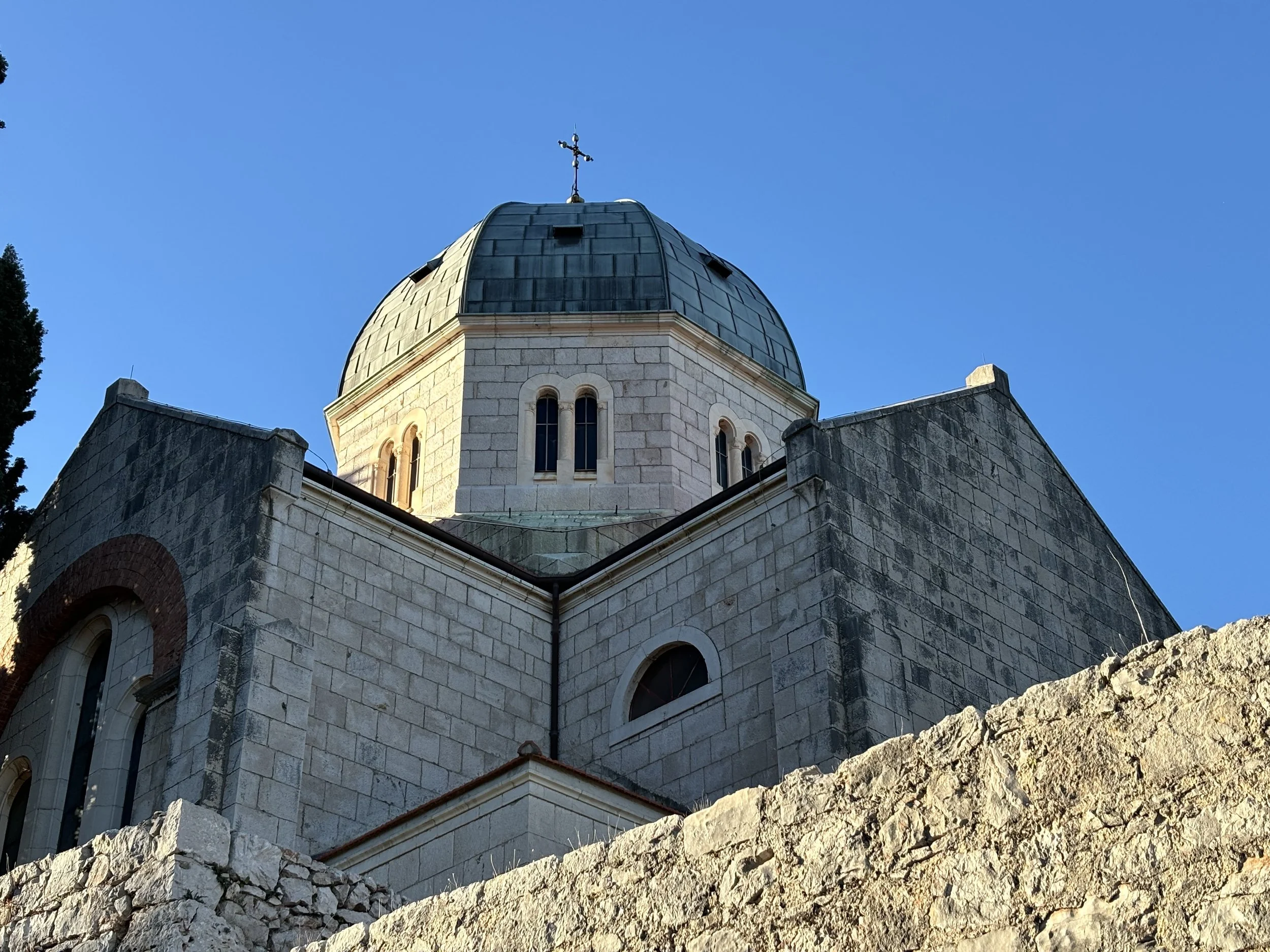
The church in Svirce // © John Bills
The road dipped into Svirče, taking me past a World War II monument that resembled a claw and a closed restaurant that I had put a lot of faith in to provide me with some much-needed fuel. My feet were done, my brain 275 kilometres to the northeast, my heart on a bench by a shallow river. Out of pure coincidence, I took a seat on a bench by the Church of St Mary Magdalene, a gorgeous building with a stunning dome and weathered walls. I had completely forgotten the point of the walk and was somewhat dismayed that I still had 45 minutes of limping left before I could take off my shoes, but that was beyond my control.
When you take those first steps, you commit to a winding road that takes you where it goes. It had taken me from Jelsa to Vrboska to Stari Grad to Dol to Vrbanj to Svirče, but it had really taken me from Liverpool to Leeds to Mostar to Belgrade to Ljubljana to Belgrade to Prague to Newmarket to Welshpool to Mostar to Sarajevo, a bench, and a face peering around an apartment door one last time. After that, it is all a blur. A dog pattered up in search of some attention, but the poor fucker could not have made a worse choice. Dog, are you? I stood up, tried to stretch, and started the walk back to Jelsa. The other two Hvar walks will have to wait. All of this is accidental.
Još malo.