Ustikolina // Safe as Houses Self-Belief
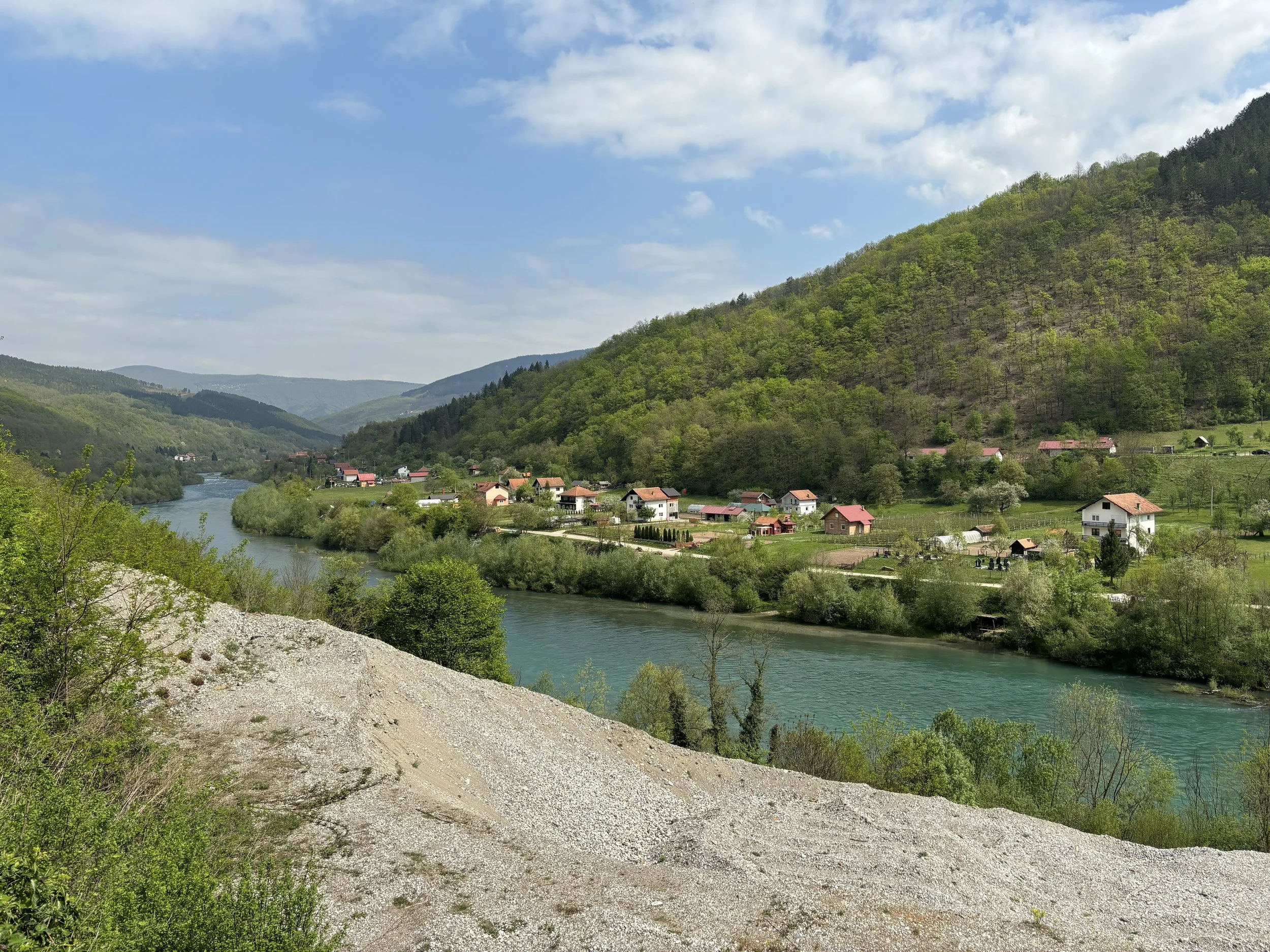
A view on the road from Ustikolina to Foča © John Bills
I am convinced that I could walk to every municipality in Bosnia and Herzegovina. That is to be taken literally. I believe that I could set out from my apartment in the centre of Sarajevo and spend my first night in, I don’t know, Vogošća, before walking from municipality to municipality until all have been visited. In a perfect world, this would be accomplished to raise money for something, almost certainly something linked to working with autistic children in the county. The best intentions, and whatnot. Maybe the power of helping others would push me up and down those hills.
Of course, it is nigh on impossible. My cardio isn’t the best, and there are many bears out there, not that they care about my dreams. There are also dogs, wild dogs, ferocious dogs. I am afraid of barking. You can read that both ways; I am afraid of the sound of barking, and I am afraid of having to bark. My imaginary wife thinks it is a crazy idea, and she is almost always right.
Still, I am convinced I can do it, and I decided to walk between two municipalities to test it. After a pleasant night in Goražde, I jumped in a taxi that took me to Ustikolina, where I would explore for a short while before walking the 12 kilometres or so south to Foča. There was no real elevation between the two and the walk essentially looked like a straight line. If I ever were to walk to every municipality in Bosnia and Herzegovina, the walk between Ustikolina and Foča would be among the simplest. If I couldn’t grasp this lowest hanging of fruit, I could sleep easy knowing the entire project was impossible. Is belief solely rooted in dreams, or can it survive contact with evidence? I don’t believe in ghosts, but I have seen a ghost.

Turhan Emin-beg Mosque in Ustikolina © John Bills
Home to fewer than 1,000 people, Ustikolina is the sort of place that appears as a pause between destinations. A handful of stores, a mosque, a church, a ranch, a couple of cafes, a few monuments. Goražde behind, Foča ahead, the border with Montenegro not too far beyond. It is unremarkable, but that says more about the beholder than Ustikolina, for this is a place that has the curious habit of revealing itself to those who linger.
This is one of the oldest continuously inhabited settlements in Eastern Bosnia, one where medieval roads converged, carrying merchants, soldiers, pilgrims, gossip, trade, and the lost and the found through the Drina Valley. Ustikolina became a modest regional centre during the Ottoman centuries, and the graceful Turhan Emin-beg Mosque is regarded as one of the oldest mosques in Bosnia and Herzegovina. Destroyed during the most recent conflict, it was later rebuilt stone by stone, standing today less as a monument than an interrupted sentence that waited patiently to be completed.
I stopped to consider the mosque and its peaceful surroundings, enjoying its quiet confidence, one built from an understanding that it has already endured every argument history could invent. The structure in front of me was both old and new, a memory, a reminder, and a response. Its minaret is one of the tallest in the country. The imam confirmed as much before begrudgingly handing me the key to the toilet, and I left the mosque relieved and ashamed all at once. Travel writing isn’t always poetic, but it must always be honest.
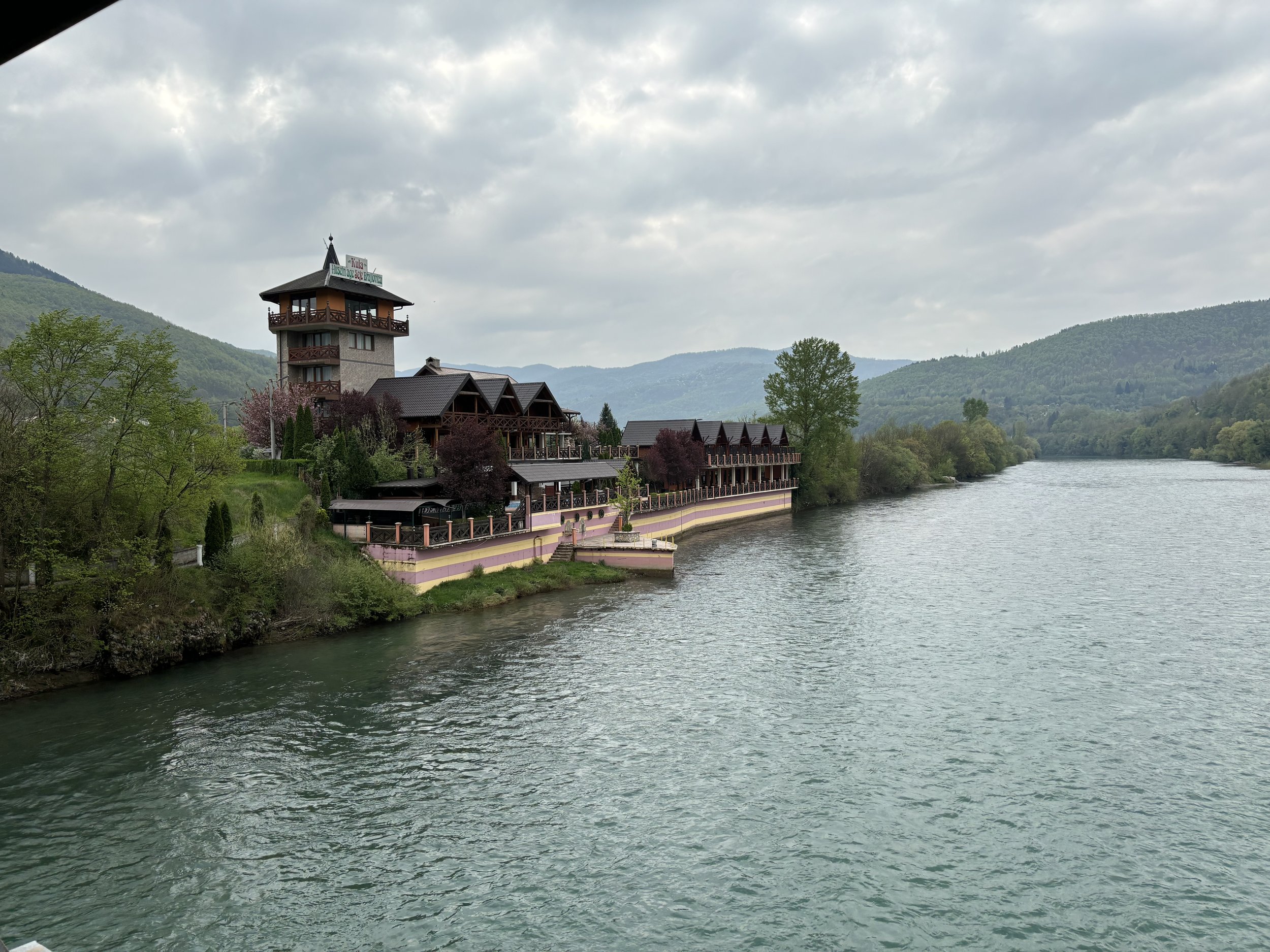
The Brajlović Ranch in Ustikolina © John Bills
My next stop was the gates of the Brajlović family ranch. For many travellers heading to Ustikolina, the road ends at this ranch, a local butchery that has grown over decades into one of Bosnia and Herzegovina’s best-known meat producers, with restaurants all the way in the capital city. If someone asks you where the best ćevapi in Sarajevo can be found, the answer is at the Brajlović ćevabdžinica in Stup. Trust me.
But the gates in Ustikolina were shut, so there was to be no morning ćevapi for me. That was for the best, as I had a 12-kilometre walk ahead of me, and a feast of grilled meat likely wasn’t going to serve as the best fuel. Caffeine was a better idea, so I stopped for a coffee at Venera before lugging Horse onto my shoulders. There was an appealing honesty to Ustikolina. It was a place where villages climbed into the wooded hillsides, a town more interested in accumulation than spectacle, and the sumptuous views remained pleasingly free from the grubby paws of postcards. I made a promise to return, the same promise I always made, but it was time for Foča.
The road from Ustikolina to Foča has no particular interest in entertaining you. It bends where the mountains insist and stays true to the course of the Drina, water on one side, forest on the other, a space where houses seem to have negotiated a peaceful coexistence with both. Within 20 minutes I had crossed from the Bosansko-Podrinjski canton into Republika Srpska and the territory of Opština Foča. Countless have died in the eternal struggle for control of this boundary, but here I was, absent-mindedly strolling through with nothing but Horse for company and no goal bigger than making it to the hotel in Foča.
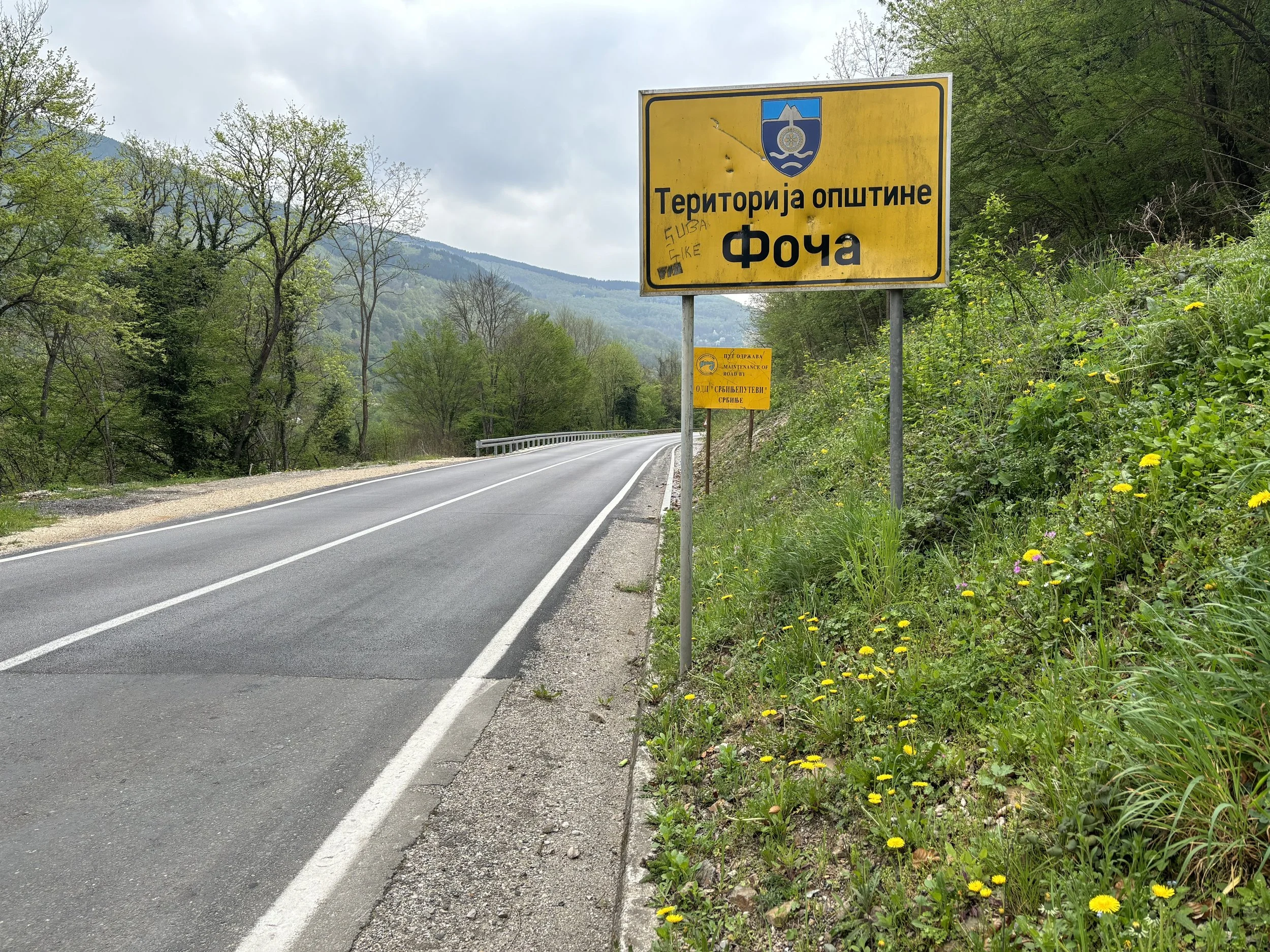
The Opština Foča sign © John Bills
An hour or so into the walk, I decided to stop for coffee at the next available opportunity. To my surprise, an opportunity almost immediately presented itself, and I sat down for the first of what would become a recurring conversation on this walk. For the sake of clarity, here’s the gist;
J: Good morning, how are you?
Konobar: Good, and you?
J: Not bad, thank you. I speak just a little of your language. How many kilometres to Foča?
K: [informs J of distance to Foča]
J: Okay, not terrible. Thank you.
The first hour of the walk was a lonely one, punctuated by conversations with Horse, but the landscape soon loosened its grip on silence. Is this what it would be like? I could do that. I could amble in the sun. My conviction grew bold. The roadside was pockmarked with monuments to those who had died young, almost all from car accidents. Growing out of those clothes turned out to mean losing certainty, but not like that. We never believe that it is going to happen to us. Each and every one of those memorialised believed with every drop of conviction in their soul that they would make it home that evening, but conviction doesn’t guarantee anything. The antithesis of Ron Hewitt’s “all those people are sleeping in their own beds tonight.” Every age is too young to die. With each passing monument, the air grew heavy, but the distant hills still folded into one another. The universe doesn’t care about us. Krauss said that makes us more precious. I’m inclined to agree.
My legs weren’t having a good time, but they were secretly having a good time. No pain, no gain, even where belief is concerned. Villages appeared and disappeared with little ceremony, acknowledging my presence with a lazy wave and the occasional repetition detailed above. Smoke rose from garden fires. I was moving in the direction of Foča, but lengthy walks have a way of dissolving destinations. It’s about the journey, not the destination, and all that jazz.
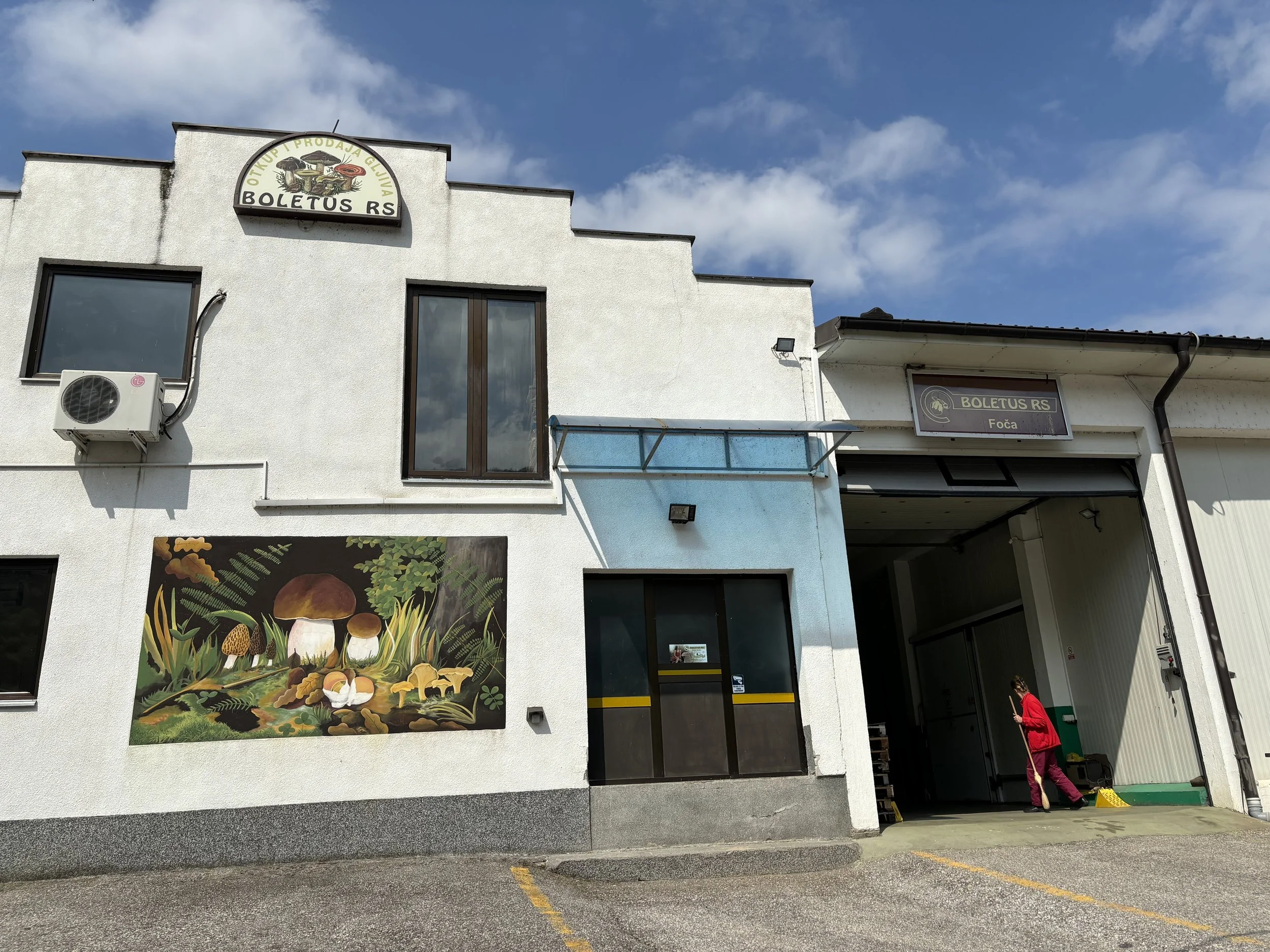
Boletus factory and shop near Foča © John Bills
My weary legs were growing ever louder, and with Foča just a few short kilometres away, I decided to stop at the next opportunity. Once more, providence arrived, this time in the form of the Boletus factory and shop. Founded in 1998, it began as a small mushroom-buying operation but has since blossomed into one of the country’s leading processors of wild forest products. After a brief chat with a factory worker (yes, the same formula), I browsed the bounty of the mountains, everything from dried mushrooms to herbal teas, fruit preserves, sweets, and more. I bought a couple of things, but the real value was in the reminder that eastern Bosnia’s greatest natural resource is not only its scenery, but the abundance that grows quietly beneath its trees.
Less than 30 minutes later, I was checking in to the Hotel Zelengora in the heart of Foča. Despite my doubts, self-belief had won the day. I had walked from Ustikolina to Foča. I wasn’t magically transformed into Jean Béliveau, but I was coated in a satisfaction that can only come from achievement. My imaginary wife was right; I couldn’t just wake up one day and decide to walk across Bosnia and Herzegovina, but she is also wrong. The dream is not ridiculous, but enormous ambitions don’t become achievable by closing your eyes tight and believing harder. They become achievable when you place one foot in front of the other, and move. Not “I’m going to walk across Bosnia and Herzegovina,” but “I am going to walk to the next town.” Little by little, brick by boring brick, the palace is built. Accumulation over spectacle. And before you know it, the mosque has been rebuilt, the local butcher is a national institution, the local factory is an empire, and the next municipality becomes the entire country. As I collapsed onto the bed in Hotel Zelengora, the reality of taking one more step was sobering, but since when has belief had anything to do with reality? I still don’t believe in ghosts, but I know what I saw. I have always had a song inside my head.