Maglaj // Eyes Covered in Moss
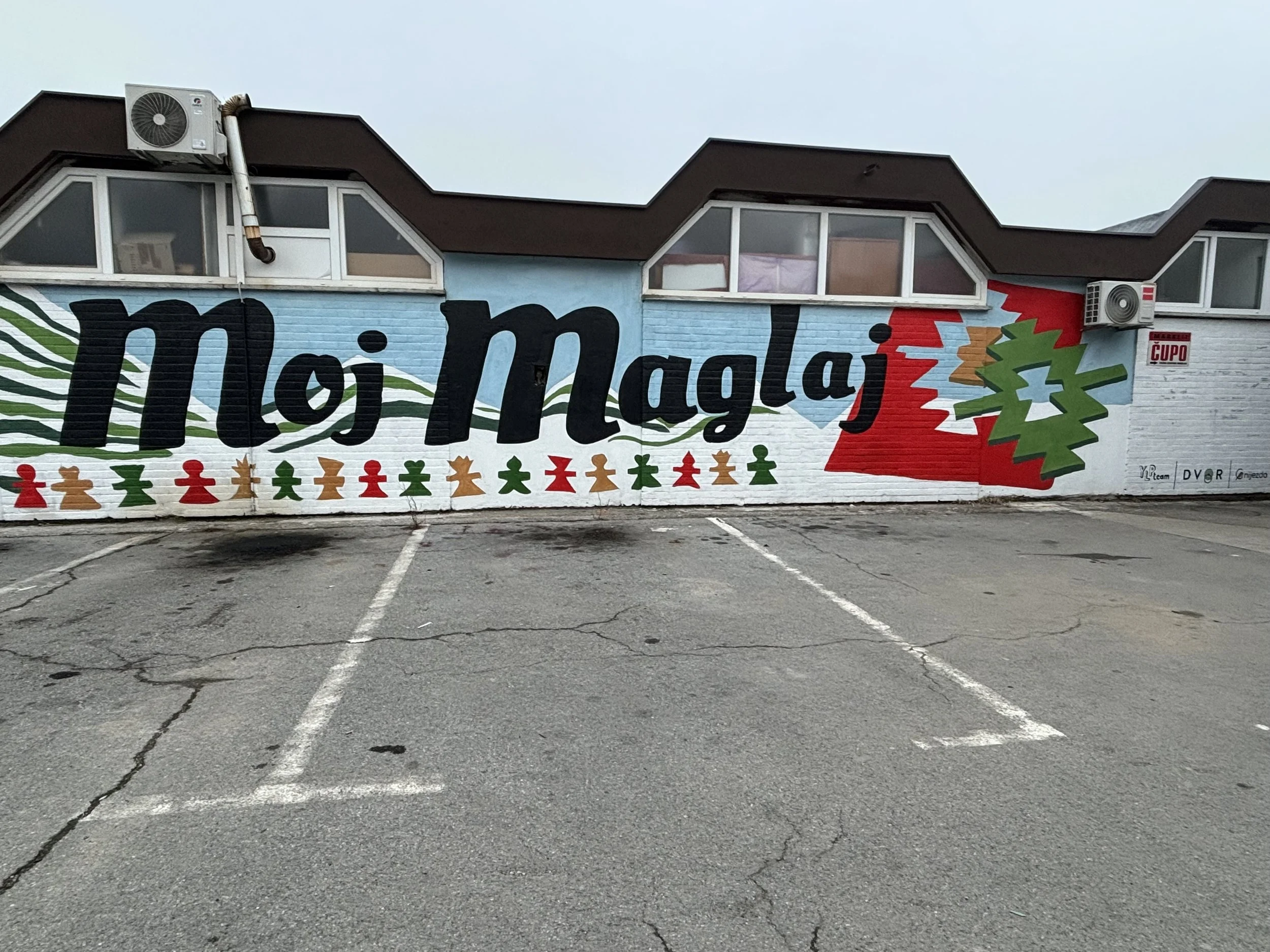
Mural in Maglaj © John Bills
There’s a lot to be said for predictability. While the joy of the unexpected is an important part of the human experience, sometimes it’s just nice when a thing is as advertised. Language is hit and miss on this front, none more so than my beloved Welsh. Despite the honest pleas of native speakers and the stubborn denials of the linguistic purists, it can appear, to outsiders, like a terrifyingly impenetrable language. I mean, Llanfairpwllgwyngyllgogerychwyrndrobwllllantysiliogogogoch exists, right? There’s also Eglwyswrw, a town made relatively famous in 2018 when it experienced 85 consecutive days of rain. If that isn’t the stereotype of my homeland, I don’t know what is.
Despite that, there are some beautifully literal words in the Welsh language. A video doing the rounds on social media uses animals as a vehicle for this, reminding an audience that we have words like buwch goch gota, which is the Welsh word for “ladybird,” but loosely means “red dot cow.” Then there’s moch daear (earth pig) for “badger” and bochdew (fat cheek) for “hamster.” Now, the illusion ends, as we don’t say pop-ty-ping for “microwave” (microdon) or pysgod wibli wobli for “jellyfish.” We don’t say cont y môr, either, despite the obvious hilarity. The Welsh word for jellyfish is sglefrod môr. All travel writers are liars, but language must stick to the truth.
Which brings me to Maglaj, a small town in northern Bosnia and Herzegovina. First mentioned in 1408, the town remains a treasure trove of Ottoman-era architecture and 21st-century neglect, a place where whispers of the past remain as lucid as ever while modern voices are lost in, yes, the mist. That’s the crutch I’m going to lean on here.
The name “Maglaj” loosely means “foggy,” and the town was sure as shit living up to that epithet as I left Hotel Edemus in search of history and heritage. The fog (niwlog in Welsh, if you’re noting those down) was thick, dense enough to rest upon. You could cut it with a knife, but not one of those old, blunt ones, no, you’d need a fresh out of the shop, shining chef’s knife to pierce this. Fog is a city’s invisible architect, a wandering kingdom built from billions of tiny water droplets suspended in the air, one that arrives when moist air cools and forces water vapour to condense around microscopic particles of dust and salt, creating the floating cover that reshapes streets and distances. It is a temporary map, one defined by rearrangement, built by temperature and humidity, a condition that softens edges and hides history. This is true, but ultimately fog remains fog. The universe is not interested in our attempts to make weather symbolic.
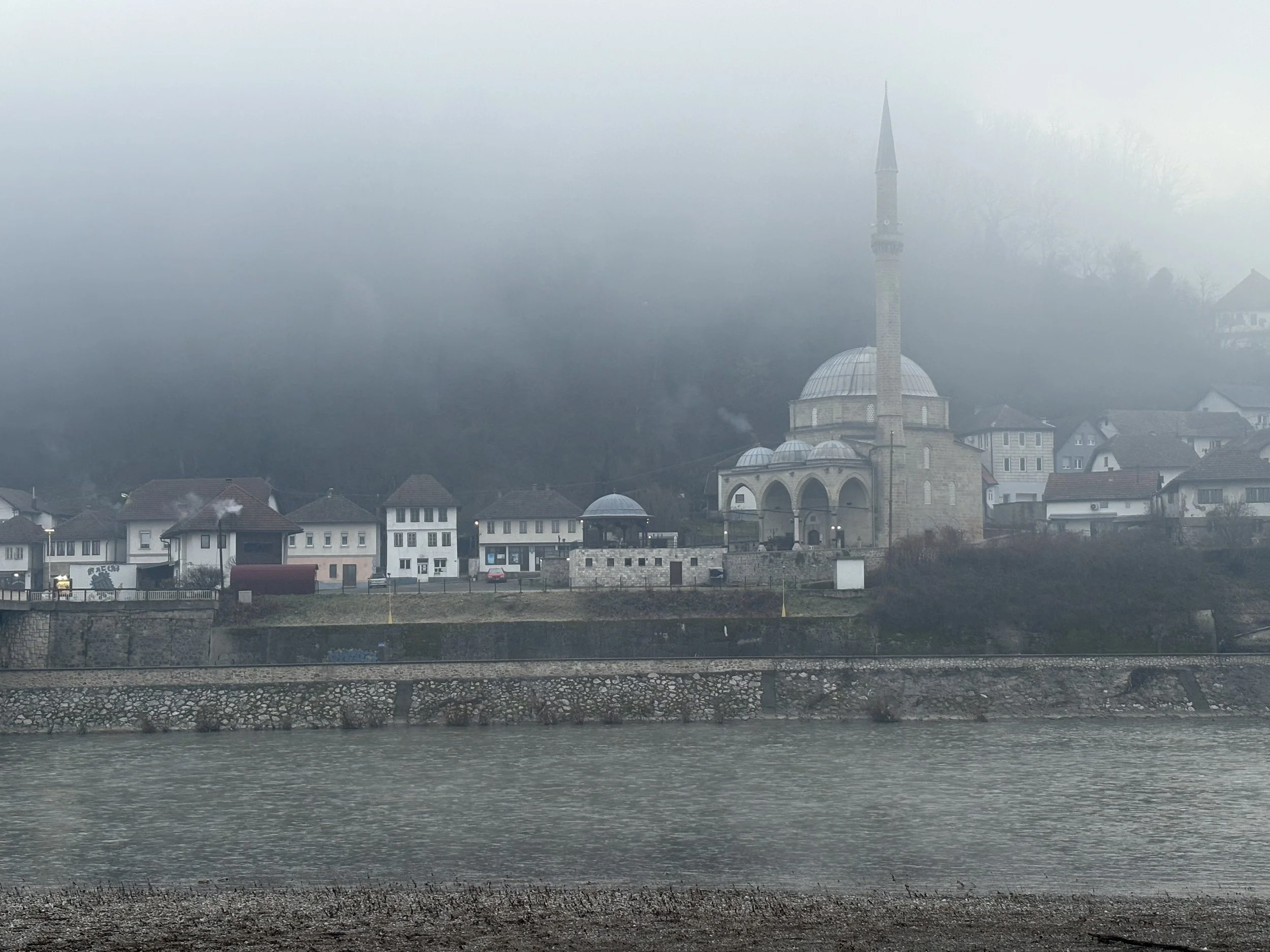
A foggy morning in Maglaj © John Bills
Long story short, the town named after fog was foggy. The conditions were far from ideal for a first-time wander around the town, but what could I do? The world doesn’t owe me a revelation. Maglaj was foggy, but Maglaj was still there. It would still be there whether I was in town or not. Strip it down, and none of these things had anything to do with each other. The fog did not know I was disappointed. The town did not know I had arrived.
In the mist, the Vali Recep Yazıcıoğlu Mosque looked even more like a spaceship. Constructed in 2009 with support from Turkish foundations (hence the name), the mosque takes Ottoman architectural traditions and implants them into the 21st century, where the dome and minaret form a familiar silhouette, but the walls are all excitement and meticulous creativity. I left it behind and continued on towards the Bosna, stopping briefly at the Sanctuary of Saint Leopold Mandic. Dedicated to the Croatian Capuchin saint known for his compassion and work as a confessor, the blocky structure was losing its impact in the fog. The fish fountain remained fantastic, but when has an animal-based fountain failed to hit the mark? My steps continued to the river, but the fog was blunting any chance Maglaj had at tugging my heartstrings. With eyes covered in moss, it is difficult to see.
But who am I to stand on this meagre pulpit and condemn a town because of moisture and light? So it was foggy, get over it. Besides, fog is a city’s way of reminding us that the world is not a stage arranged for our arrival. Every day, we step forward expecting perfect views, sudden understandings, rewarding landscapes, and logical answers, but the universe has never signed such a contract. It withholds as often as it reveals, but none of that has anything to do with us. Beauty does not announce itself, but sometimes it asks us, not explicitly, to proceed without proof. Life offers no guarantees, no explanations, but here we are, breathing, moving, continuing. The smallest things are all it takes. A kind word, a good hair day, a joke made for two, or the most beautiful human of all the humans wearing a cap in a funny way. Life takes you where it goes. We walk through the grey, guided by a stubborn, unreasonable faith that something waits around the corner. Push me, push me. There is something extraordinary in that.
And just like that, as if by magic, as if by divine intervention, as if to prove the previous 1,000 or so words utterly superfluous, the fog lifted. It didn’t happen immediately, it took a little while, but for the purposes of this exercise you can feel free to imagine it lifting in a literal sense. The foggy city was now bathed in a morning light that bordered on the brilliant.

Sahat Kula in Maglaj © John Bills
I made a beeline for Maglaj’s fortress, a 15th-century fortification that sits above the Bosna like a thought the centuries never managed to erase. There wasn’t a huge amount left, but 600 years of history will do that. The fortresses of Bosnia and Herzegovina reward the strange partnership between research and imagination. This hill has watched armies, merchants, travellers, pilgrims, and more pass below, and all that remains is suspended between earth and sky. Beside it, the Sahat Kula kept its patient watch, measuring time in all meanings of the word. From here, Maglaj looked a world away yet clear, a collection of paths and roofs that expanded beyond the bridge.
And in this fresh light, the sharp edges of the Kuršumlija Mosque shone with elegance. This 16th-century Ottoman mosque is the city’s brightest light, a carefully folded page from another time that has watched Maglaj change around it, acknowledged every passing empire and every redrawn street with the quiet confidence of someone who knows what is coming. Its name means “leaden mosque,” a term that comes from the dome that once crowned its roof, but the structure today is extraordinary in its grace. A quiet point of balance, if you will.
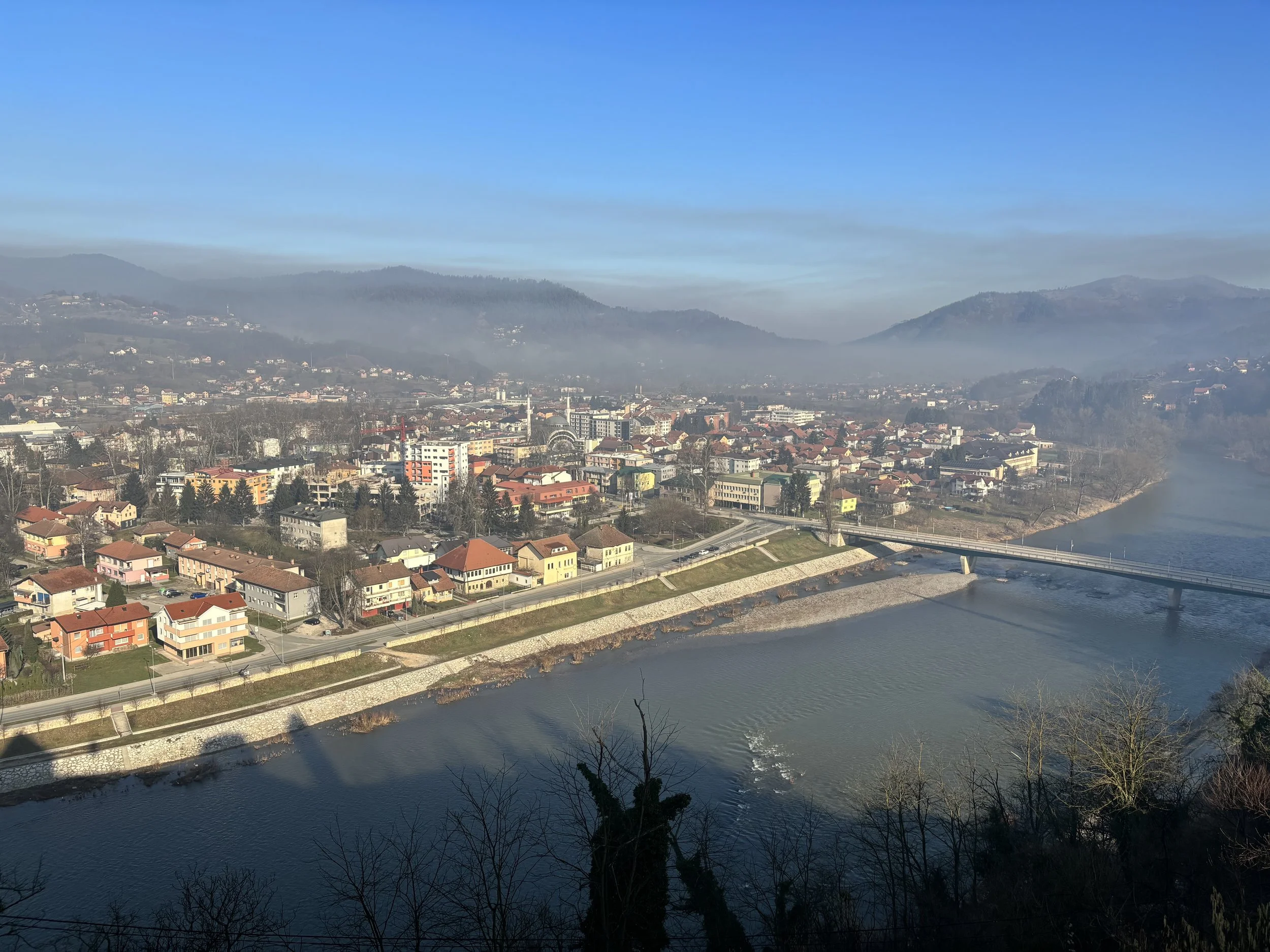
Morning view of Maglaj © John Bills
Free of its morning haze, Maglaj was blossoming. I stopped briefly at the 19th-century Delibegov Han, a small doorway into the travelling world of Ottoman-era Bosnia, when roads were measured in distance and detail. Built as a roadside inn, this structure offered shelter to merchants and wanderers moving through the region, creating a temporary home for those always between destinations. These were people who had set off from distant homes on journeys inspired by hope, by blind optimism that everything would work out. The past was brutal, but it was also a time when hospitality was a form of architecture. A short walk away sat the Uzeirbegov Konak, another 19th-century structure, this one a residence for a local notable. The building was locked (it was very early on a Saturday morning, so I won’t hold this against Maglaj), but its grace was apparent from the outside. It was a memory preserved in timber and stone, a glimpse into a Maglaj gone but not forgotten. I was running out of time, but I made a point of stopping at the big ball monument. No, I’m not going to expand on that.
It was time to go. Maglaj had revealed itself as a beautiful city, one shimmering with history, a town where architecture and art are synonyms. I felt a mild irritation that I couldn’t spend more time, but was also thankful that the fog had lifted when it did. What would have been my opinion if it had only formed in the mist?
When I left the hotel, Maglaj was shrouded in fog. There was no indication that it would lift, but a layer of mist didn’t exclude the town from existing. I had to walk, fog or not. The eventual sunshine was a gift, not a promise. Most worthwhile things require an irrational optimism that often leaves us bewildered, sometimes even disappointed. Even so, we continue. Life is worth loving, even when it isn’t. You don’t continue because you know that joy is waiting. You continue because stopping guarantees that you won’t get to experience it.