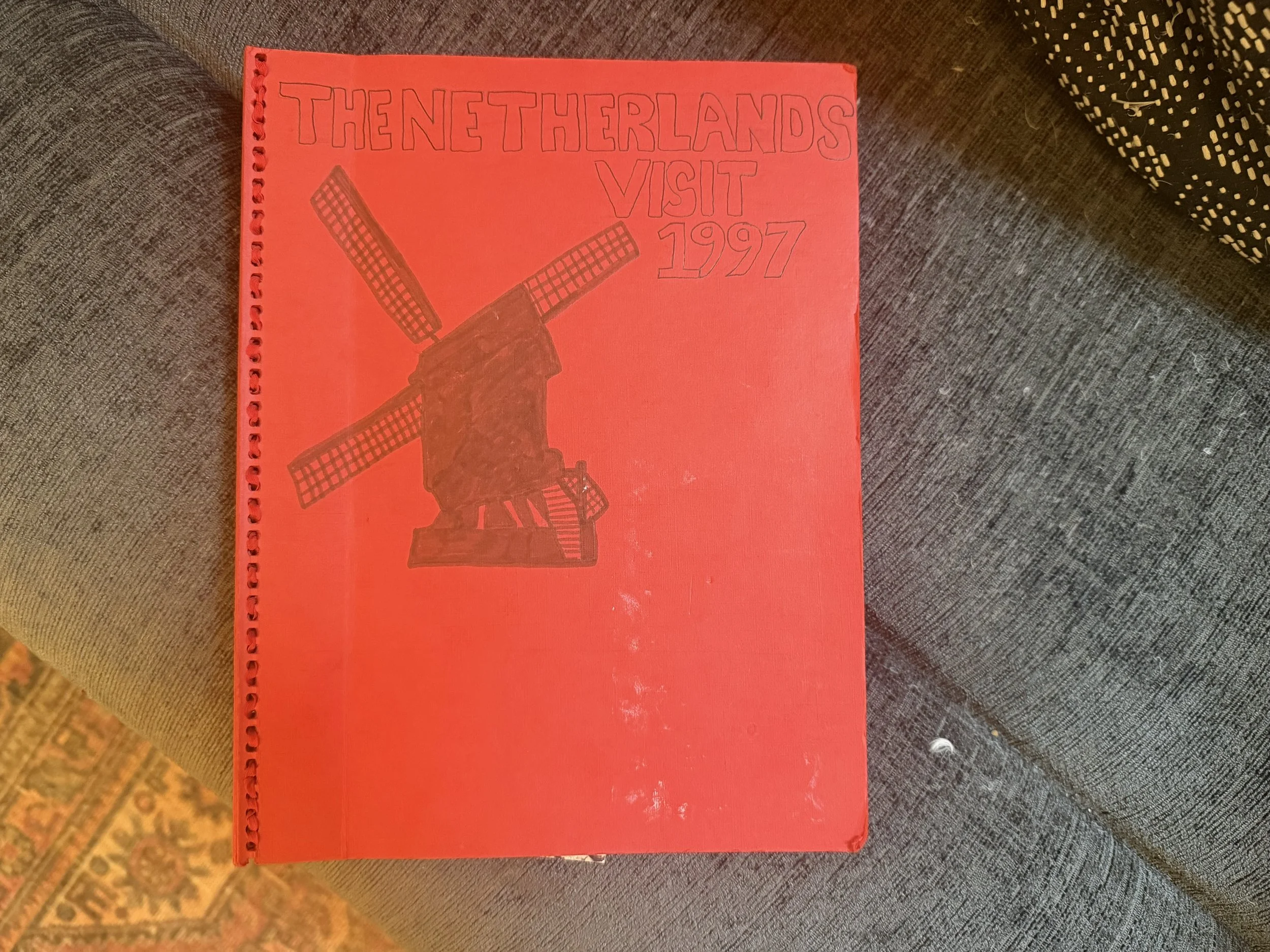
The cover of my Maastricht diary. Hand-drawn, I presume // © John Bills
“Thursday 20th March.
The time was quarter to four. I was ready to go overseas without my parents for the first time ever, I was excited, but I was also a bit nervous. Mum drove me to school and loads of people were there already. Mr Griggs called a register and excitedly we dragged our bags to the bus. We left Welshpool at 5.06 a.m., waving goodbye to our parents.”
“We chatted merrily on the bus, and we listened to music, and before we knew it, we were at the services. After the services, we made our way to Dover, and to the ferry. On the ferry, I could feel the waves going under the boat. We arrived in Calais at 2.25 p.m. Central European Time. Straight away, we could see a beautiful beach. At the border between France and Belgium, policement were standing with machine guns. We stopped at a supermarket in Calais, the teachers went in and supposedly bought milk and butter but they bought loads of booze. When we arrived in the Netherlands at 18.44 p.m. Central European Time, we drive over the River Mas. That night we went to a cafe called Cafe Zaal de Pul and we had an ice lolly which were like calippos. For tea, we had chips and a burger, and it was lovely.”
A strong start, Bills. I particularly like the use of “dragged” and “merrily,” really setting up the inherent confusion of being 11 years old. The mention of the waves under the ferry is a lovely touch, showcasing a keen sense of scene, even at such a young age. Accusing the teachers of buying alcohol was a brave move, but your experiences as an adult mean it was a somewhat vindicated move. The repetition of Central European Time is fun, and I’m hoping that 11-year-old John was using it as a reference. I believe in you, young John.
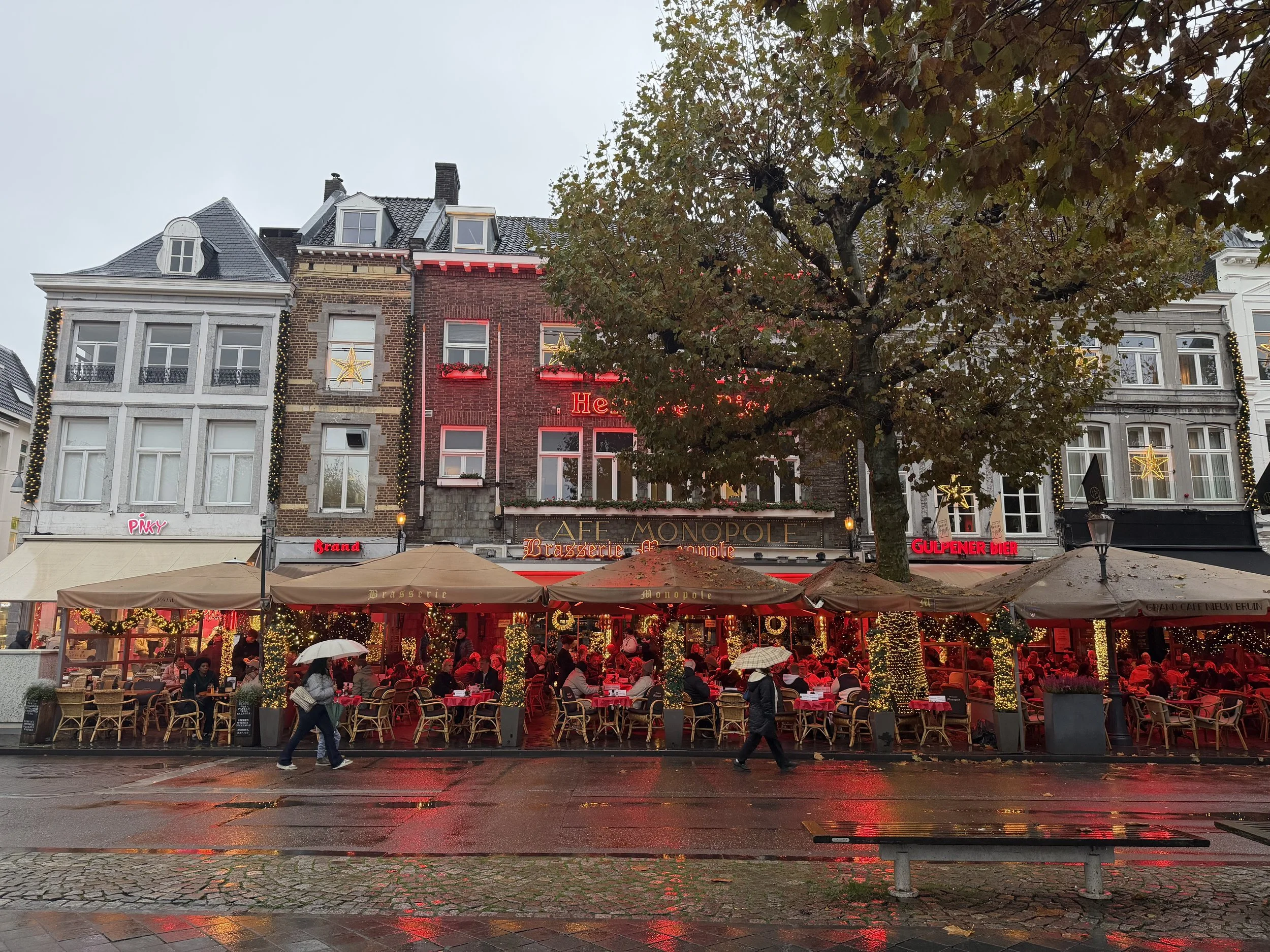
Soggy Maastricht in November 2026 // © John Bills
And I don’t want to be that guy, but it’s the River Maas (Meuse in French and English). Just 29 years later, I was back in Maastricht, again crossing the River Maas in search of burgers, chips, and booze. The eagle-eyed (cherry) among you will work out that the river and the city are best buds, but Maastricht and the Maas have a strange historic relationship. On the one hand, the river is an integral part of the city’s identity, dividing Maastricht into two distinct halves, and forming a backbone here for almost 2,000 years. The Romans built a bridge, the Mosa Trajectum (crossing on the Meuse), and that gives us the name. On the other, there was always something of a disconnect between Maastricht and the Maas. Its banks were lined with high defensive walls, some incorporating the city’s historic fortifications, engineered embankments that helped contain the river and protected the urban area but prevented the people of Maastricht from accessing the waterfront. I want to avoid the simple take, but Maastricht was a city built across a river, not alongside it.
I didn’t know that in 1997. I didn’t start geography lessons until the first year of high school.
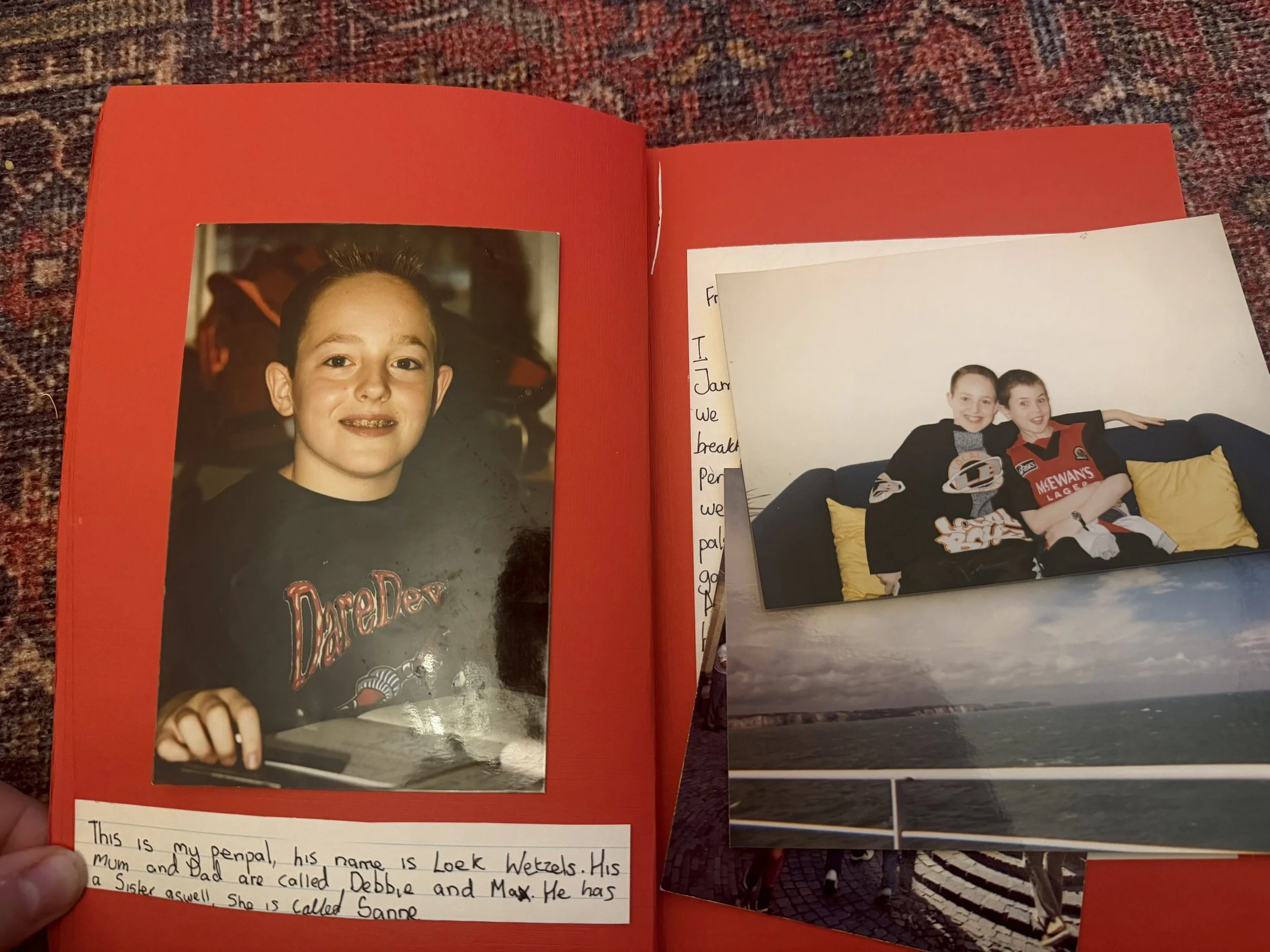
Loek! And a classic Blackburn Rovers shirt // © John Bills
“Friday 21st March.
I woke up with roommates Scott Jones, James Sharpe, and Matthew McWhinnie, and we went downstairs to eat our breakfast. After breakfast we went to Maastricht to meet our penpals. We were all a bit nervous and when we reached the Fons Ortiffson School our penpals were waiting for us. We played them in a game called Block Ball and we thrashed them. After I went to see my penpal, who is called Loek. His friends were funny as well. His mum and dad bought me a football and a mug with my name on it. For tea, they took me to McDonald’s, which was next to MVV Maastricht’s stadium. I had chicken nuggets and chips and it was lovely. After McDonald’s, I met Sharpy and Andrew and afterwards we played on the slide. That night we all stuck our pyjamas on and went to a pyjama party organised by Mrs Price. We went to sleep after me and my roommates had a Mars Bar fight which turned into a free-for-all.”
Loek Wetzels. His parents were called Debbie and Max, and his sister was called Sanne. If you’ll allow me the easy road, I wonder how they all turned out. My memories are spotty, fuelled primarily by the bizarrely well-written diary from 1997, but I do remember the Wetzels family being very pleasant. They taught me some Dutch: Ik ben elf. Ik ben stom. All in good humour, I hope, although you could argue that all 11-year-olds are stupid in their own ways. The Wetzels were kind, and I dearly hope that everything worked out. I hope they remember me well, if they remember me at all.
In further proof that our creator has a sense of place, my hotel was directly next to the stadium. Stadion De Geusselt, for the record. I toyed with the idea of visiting the McDonald’s, but struggled to justify it at my advanced age. Zoervleis exists, you know? Given the choice between nine nuggets and fries or a slow-braised beef stew with vinegar, onions, spices, and syrup, and, well, I’d probably go for the nuggets, but I’d be happy with either choice. Ik ben geen 11. Ik ben nog steeds stom.
And MVV Maastricht? Founded in 1902, Maatschappelijke Voetbal Vereniging Maastricht (if we’re being formal) is one of the country’s oldest football teams and a robust cultural institution in the city. Known as De Sterrendragers (the Star Bearers), MVV are a people’s team, one rooted in the neighbourhoods and communities of Maastricht (the long name loosely means “Maastricht Community Football Club,” but let’s slow down on the parentheses here), and its survival has repeatedly depended on the loyalty of local supporters and businesses. A common story across Europe, all too common, unfortunately.
I sincerely doubt that we thrashed the Dutch at Block Ball. Probably a little hyperbolic there, buddy.
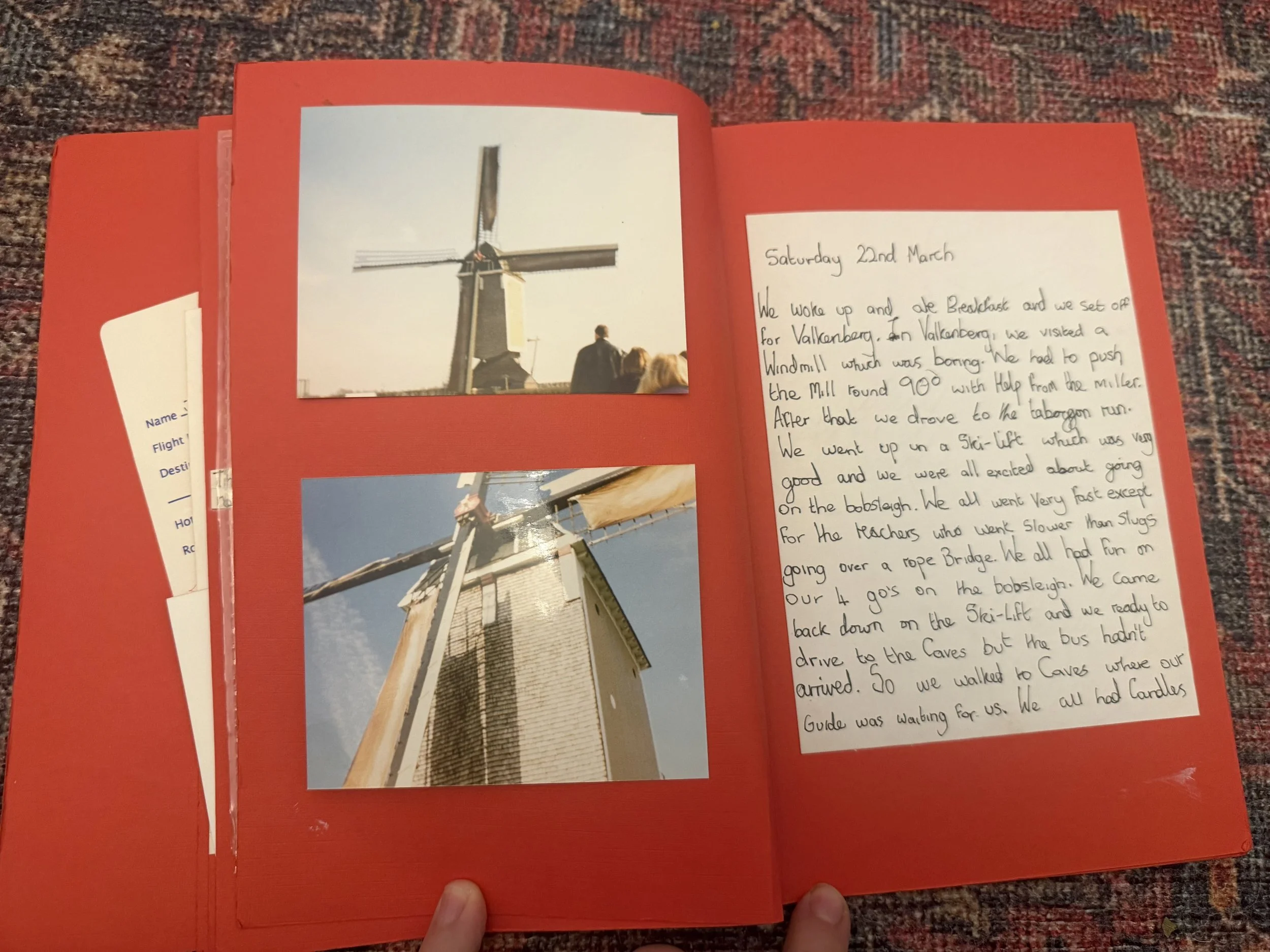
Some fabulous mill photos from 1997 // © John Bills
“Saturday 22nd March.
We woke up and ate breakfast and we set off for Valkenburg. In Valkenburg, we visited a windmill which was boring. We had to push the mill around 90 degrees with help from the miller. After that we drove to the toboggan run. We went up in a ski-lift, which was very good, and we were all excited about going on the bobsleigh. We all went very fast except for the teachers who went slower than slugs going over a rope bridge. We all had fun on our four goes on the bobsleigh. We came back down on the ski-lift and we were ready to drive to the caves but the bus hadn’t arrived. So we walked to the caves where our guide was waiting for us. We all had candles so we could find our way around the caves. Around one corner, there was a statue of Princess Cecilia lying down after being hanged. The caves got better as they went on and when we reached the end of the cave we had all forgot what the sun looked like. After that, we went to a coal mine, which, in my opinion, was the down point of the day. The miner just went on and on about mining in the old days and told us strictly that the country we called the Netherlands, not Holland. Then we went 10-pin bowling, and were split into groups of 6. Me, Scott, Sharpey, Gemma, Donna, and Claire. Scott won with 75 points. I came 2nd from last with 55 points. Once I aimed to get 0 pins but instead I got a strike. When we got back we had our tea and went upstairs to tell ghost stories. We had just started when there was a power cut. At first, we blamed Danny for turning off the light but when we realised he hadn’t, we all screamed! My room was next to a graveyard which made it even more scary. Finally we all fell asleep.”
A little light on details, but it is to be expected from such a young writer. At that tender age, ten-pin bowling is always more exciting than a windmill. The only real point of irritation is my poor performance with the pins; 55? John, you’re better than that. Even at 11. I would also like to formally apologise to Danny Smith for incorrectly blaming him for the haunting.
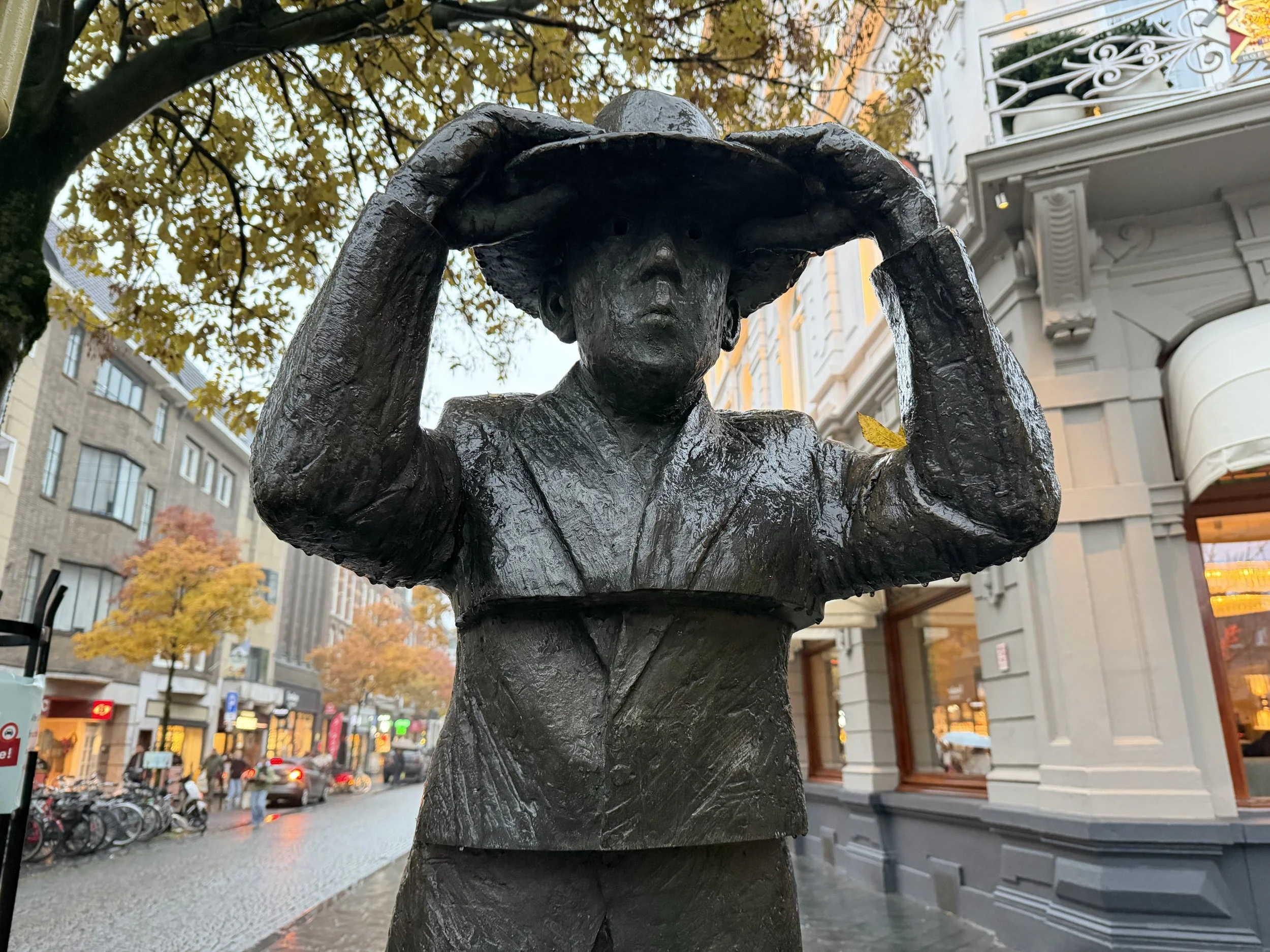
A wacky statue in Maastricht // © John Bills
There's a drawing of a mill on the diary's front cover, despite my insistence that it was boring. Eleven-year-old John had a keen sense of cultural recognition, it would seem. Unfortunately, I can’t work out where this particular mill was and have zero recollection of it, which makes this section somewhat difficult. To make matters a little more confusing, the mills of the Maastricht area don’t really fit the Dutch stereotype, as water rather than wind did much of the heavy lifting in these parts. Back in the 16th century, there were reportedly 15 to 20 watermills within the city walls, the engines of the local economy. All good and well, but it doesn’t help our attempt to turn back the clock. Could it have been the Van Tienhovenmolen? Not in Valkenburg, but not too far away, sitting on the open Plateau van Margraten, its sails ticking the Dutch windmill stereotype box. It was built by a local chap in the middle of the 19th century, and its most notable characteristic is that almost the entire thing is made from locally quarried marl, the only windmill in the country made predominantly from this distinctive pale limestone. Could it have been that? Does it matter? The mill existed for a group of Welsh kids in 1997, but the bored class from Welshpool were just another collection of faces in the life of a working mill. It did its job. It does not need to neatly fit into my recollection of events.
Besides, this note about the hanging of Princess Cecilia needs some attention, right? My best guess is we found her at the Museum Romeinse Katakomben, the Roman Catacombs Museum, an elaborate reconstruction of early Christian burial chambers and underground passages found in Rome. The candlelit tour is the giveaway. Why would we have gone there? How important is why? I don’t think Cecilia cared. Besides, she was a saint, not a princess, and her death was a slow, torturous one following a botched beheading, not a hanging. Cecilia was born into a wealthy Roman family, married a pagan, and convinced him to convert to Christianity. This didn’t go down well with the authorities, and she was sentenced to death by suffocation in the steam room of her own home, which became death by beheading, which became death from your wounds following a botched beheading, which became a misremembered line in the diary of an 11-year-old boy from Welshpool, Wales.
If 11-year-old John wasn’t interested in the mine, 41-year-old John need not stress about it.
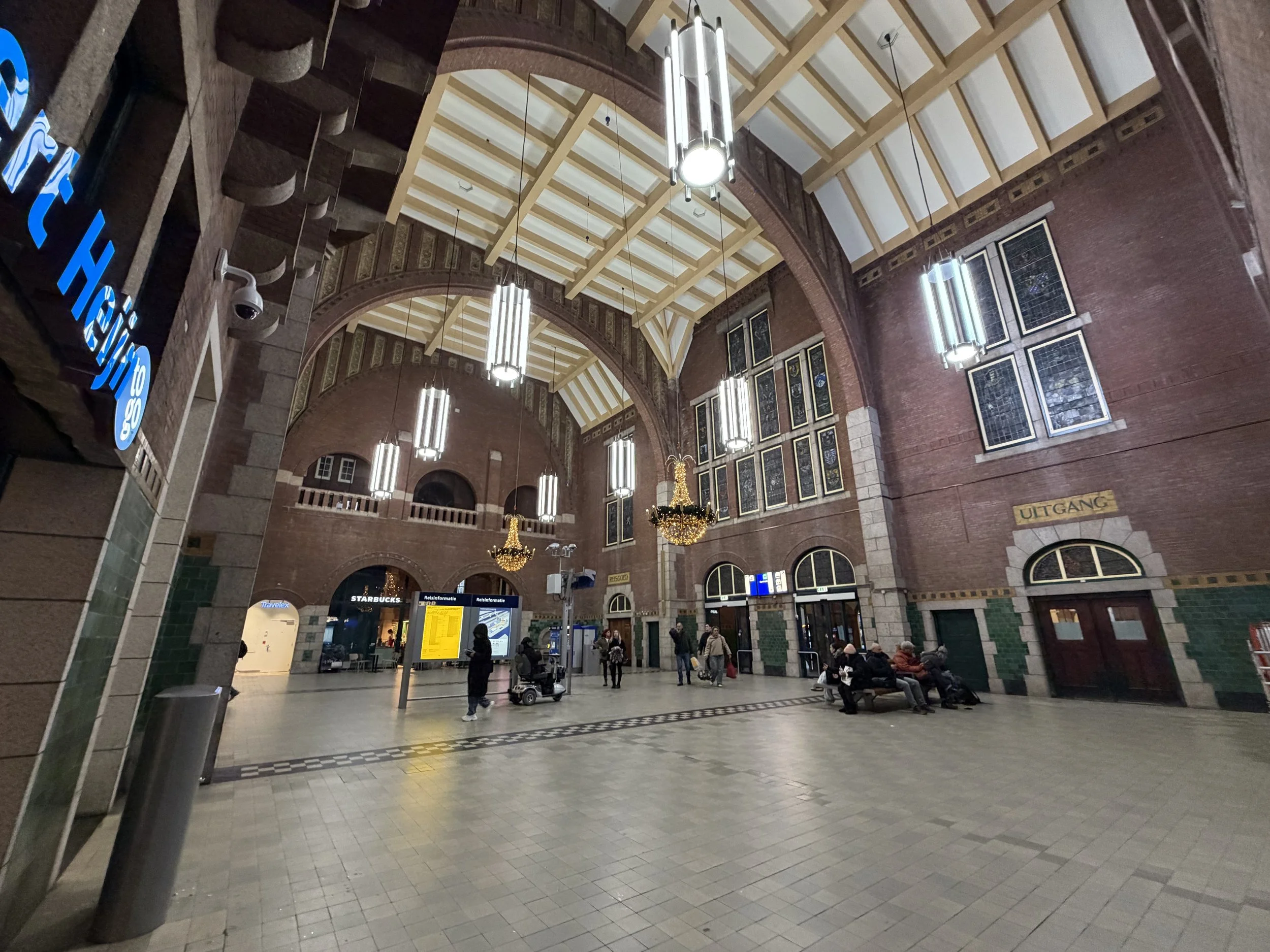
The interior of Maastricht train station // © John Bills
“Sunday 23rd March.
Again we woke up, gave our keys to Pieter, who is the owner of the hotel, and we went to eat the same old breakfast. But to our surprise, we also had cereals to choose from! Everyone on my table had Frosties. Then we went to Valkenberg to go in some adventure caves! First, we had to put a harness on and off we went! We made our to a big room which looked like Gladiators! Then we had to climb up a ladder and then over a rope bridge. Then we had to walk on a ledge to get to the zip line. We were all nervous, but one by one, we zipped down the zip line, which was great. Then we had to crawl through a tunnel which was really small. At one point we had to cross over water in a boat then walk across a plank. It was brilliant. At the end, we had to climb up a manhole. Then we went swimming, which was brilliant. I went on the slide nine times and I nearly went over the slide. For a few times a load of us went down in a chain of 10! Then we went shopping and I bought chocolates for my family. We came back, got changed, and went downstairs where our penpals were waiting for us. I bought my penpal a drink and we all went to the disco. We started dancing on the tables and it was really good. At 12.05 a.m., we went to bed after waving goodbye to our penpals.
“Monday 24th March.
We woke up and ate breakfast. We packed our bags, had a drink, and set off for Calais. We reached Calais at 12.30 p.m. and went on the ferry. We went on deck and looked at the view. We moved our clocks back one hour when we reached Dover and we set off again for Welshpool. We stopped at the Watford Gap for an evening meal. We had burger and chips and it was lovely. We set off again with our destination hoping to be Welshpool. We reached our destination at 10.19 p.m., and Mum drove me back home. I told my family all about my lovely holiday and I told them how much I enjoyed it.”
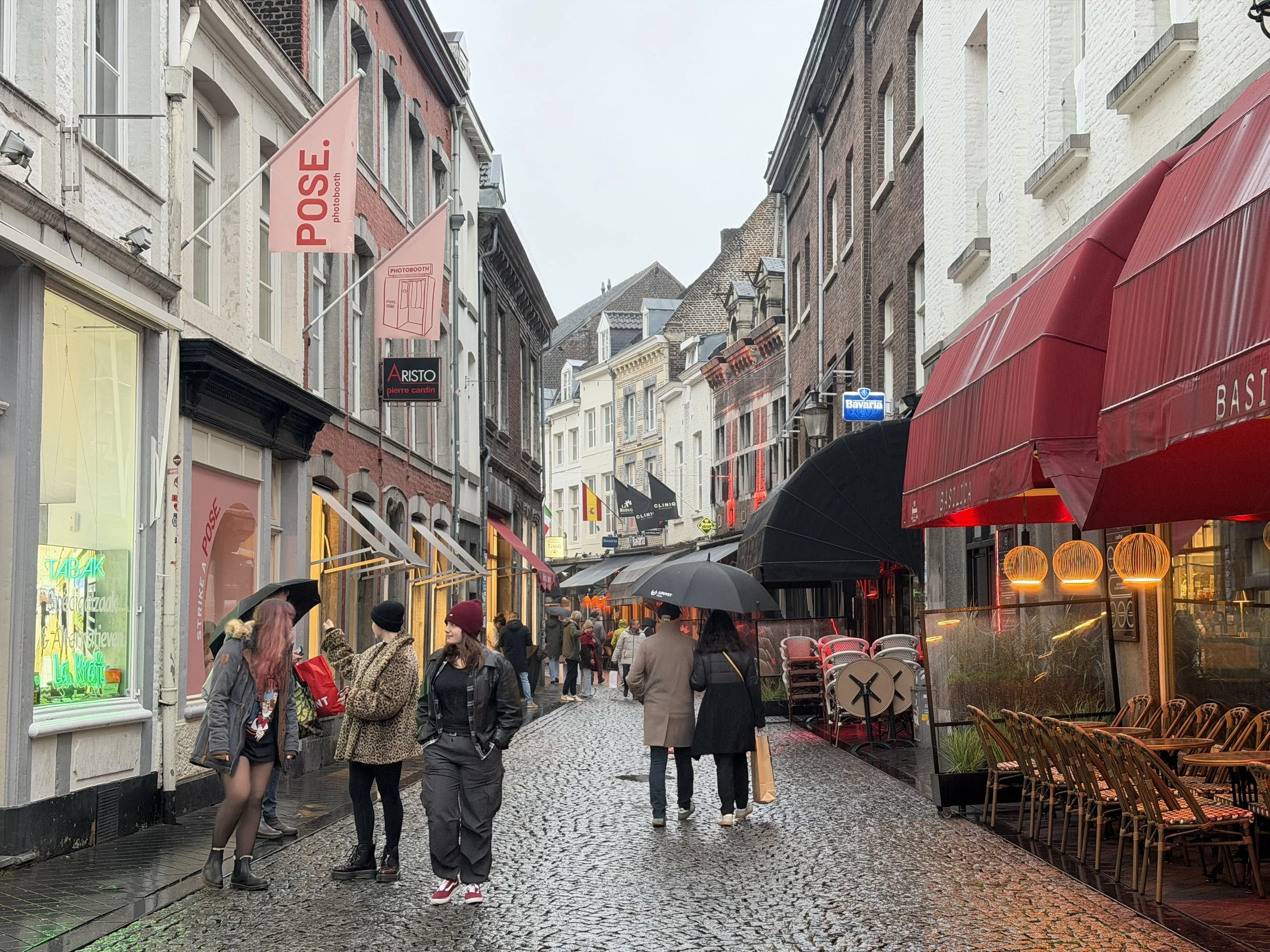
A rainy street in Maastricht // © John Bills
We can lump these in together. My tendency to rush through to the end of a piece of work was obviously a characteristic I picked up at an early age, although the “zipped down the zip line” is quite fun. My original idea here was to put the 2026 trip side by side with 1997, striking a balance between the wide-eyed excitement of an 11-year-old and the somewhat curmudgeonly exhaustion of a man on the cusp of his 41st birthday, but somewhere along the way, that idea lost its vigour. We’ve already dredged enough melancholy from the world I inhabit, why not celebrate the innocent excitement? In 1997, everything was brilliant, everything was lovely. We danced on tables, we threw ourselves into every activity, we lived as though the world was something to be embraced, free of cynicism and fear. I told my family about my holiday, and I told them how much I enjoyed it. There is no grand concept, no attempt to imbue the simplicity of an experience with trite philosophy.
Where did that boy go? I recognise the handwriting, the names, some of the experiences, the sparkling flashes of personality, but nearly 30 years have passed. In that time, I have lived an entire life. I have seen actual death in Welshpool, and I have seen actual magic in Dobrinja. What would 11-year-old me make of it all? In 2026, I returned to Maastricht, stayed at a hotel by the stadium, wandered its winsome streets, talked about life with taxi drivers, and made a half-hearted effort to draw a line between innocent hope and jaded despondency. I tried, but the rain was a little too heavy, the legs a little too tired, the memories a little too hazy. I hope Loek and his family are well, and I hope 11-year-old John isn’t too embarrassed. Budi nježna prema sebi.
I’m not bothering with the gender. You get the point.